Red Ear Sliders, Sea Turtles and Other Turtle Species


May 9, 2008


Red Ear Sliders, Sea Turtles and Other Turtle Species

     All Turtles
        Home


    Your Turtle /
         Tortoise Pictures!

    Turtle Adoption

    Save the Turtles

    Turtle Gift Shop

    Turtle Humor

    More Turtle/Reptile
         Links

    Site Map


First Aid


1)

Turtle not eating

9)

Skin wounds and rashes

2)

Frequent sneezing, coughing, yawning

10)

First aid for bites and injuries

3)

Swollen eyes and Vitamin A injections

11)

Drowned turtle

4)

Vitamin K deficiency

12)

Prolapse

5)

Shell diseases

13)

Rock ingestion

6)

Shell sores or holes in shell

14)

When is it time to see a veterinarian?

7)

Repairing your turtle's shell

15)

Turtle shell preserving

8)

Algae on your turtle


1) Turtle not eating:

Here are some questions to ask yourself.

Is the temperature of the tank warm enough?
If turtles get too cold, they don't eat as much and start thinking about their long winters nap.

Does your turtle like the food you are offering?
Some turtles, like humans, are very picky eaters. They have their favorites and their not so favorites. Start off with their favorite foods first, then slowly introduce other menu items.

Is your turtle under any stress? Are they being handled too much, traveling lately, or do they have new tank mates?
Many new animals often experience this stress and it may cause them to not eat properly. Just keep trying and have lots of patience. They may take several weeks before they eat again.

Your turtle not eating may also be a sign of illness.

2) Frequent sneezing, coughing, and yawning:

It's okay if your turtle does this occasionally. However, too much could be a sign of a respiratory infection. A common infection is pneumonia. The recommended thing to do is take your turtle to the veterinarian. They can give your turtle x-rays and antibiotics. Your turtle is going to need a lot of care and chicken soup! (Just kidding on the soup part)

A good prevention technique is to make sure that the temperature in the tank is not too low. Raise the temperature up a little, this will help your turtle's immune system become more active. Colds, respiratory infections, and pneumonia seem to be the most common cause of death in turtles. Treatments for this include warmth (for the immune system), antibiotics (oral or injected), steaming, oxygen (water in the lungs means that there isn't enough oxygen), and x-rays (to check for water in the lungs).

3) Swollen eyes and Vitamin A injections:

Swollen eyes are common in turtles and usually pneumonia related. Poor nutrition and dirty water could cause this as well. If your turtle is sluggish, not eating, or shows any other symptom along with the swollen eyes, take your turtle to the vet. It sounds like your turtle may have a serious health problem and could need antibiotics.

Vitamin A deficiency could be another one of the many causes for the swollen eyes. I have read that soaking your turtle twice a day for 15 minutes in a separate container and using a saline solution or Turtle Eye Clear will make your turtle more comfortable. It will help if you start this treatment immediately upon noticing the problem. You can add a small amount of vitamins to their food every other day.

Don't just assume that it is vitamin A deficiency. Try and rule out other possibilities first. If the problems persist and don't seem to be getting better, take your turtle to the vet.

4) Vitamin K deficiency:

Bleeding through the mouth is a common indication of vitamin K deficiency. Lack of vegetables seems to be the main cause. To treat this you should give the animal vitamin K and change their diet to include more veggies. I also highly suggest taking them to the vet.

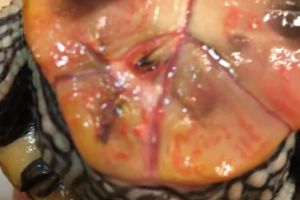
5) Shell diseases:

Your turtle's shell should be hard and solid, except for softshell turtles. You should not be able to push dents or find any soft patches. The most common cause of a soft shell is a lack of calcium or vitamin D3. They can get calcium through their food, and vitamin D3 through sunlight or UVB rays. Be patient, this could take a very long time to heal.


Fluker Farms Repta-Calcium Dietary Supplement

Use this premium powdered calcium supplement as a coating for the foods you feed to your lizards, snakes, turtles and frogs.


6) Shell sores or holes in shell:

Remove your turtle immediately from the water and keep it dry. To prevent your turtle from dehydrating, soak them for 30 minutes twice a day. Sponge your turtle off with Betadine or Nolvosan several times a day, especially after soaking them. Keep your turtle warm. Drying out the affected area aids in the healing process. Take your turtle to the vet if the problem persists.

You can prevent this condition with a proper diet and clean water.

7) Repairing your turtle's shell:

If this is the first time you have had a turtle's shell crack on you, I strongly suggest the help of a veterinarian. Here are the basic steps in repairing the shell.

1. Wash the wound out with an antiseptic.
2. Apply an antibiotic.
3. Close the wound with an epoxy.

8) Algae on your turtle:

Some algae is ok, it helps with camouflage! You should remove some of the algae if it seems excessive. Ensure the shell is clean if your turtle has had a shell problem previously.

To remove the algae, use a soft brush (like an old tooth brush) and brush it off. You can do this under warm running water.

9) Skin wounds or rashes:

Take your turtle out of the water and keep it dry. Disinfect them with betadine or a mixture of equal parts Nolvosan and water. Take your turtle to a vet if the problem doesn't seem to get better or gets worse.

10) First aid for bite or injuries:

Is your turtle alive or unconscious? If they are unconscious, they may need oxygen. I wouldn't recommend mouth to mouth, however a light puff of air in their face may help for oxygen.

If they are bleeding heavily, you need to stop it. To slow the bleeding, cool your turtle down. You should clean the wound with use hydrogen peroxide or Betadine to prevent any infection.

Your turtle may be in shock For at least 48 hours you should cover them with a clean towel and keep them in a clean, cool, dry place. You should clean the wound regularly.

Severed limbs may heal over with no complications in most cases. The affected area will heal itself as best as it can. The part that won't heal will just shrivel up and fall away. It is your responsibility to keep it clean. If infection occurs, take your turtle to the vet.

Leave your turtle alone to heal, but do the necessary tasks.


To ensure a long healthy life for your turtles,
I recommend this book from Amazon.com.

(link will open in a new window)


11) Drowned turtle:

If your turtle has drowned, they may still be alive but unconscious. Remember, they can be with out oxygen for a long time. Never turn turtle on its back! If you do this, you may eliminate it's only airspace left.

Here are some steps to take.

1. Grasp the turtle's head behind the ears at the base of the skull and extend the neck completely.
2. Turn it head-down / tail-up and open its mouth. Some water will drip out.
3. After the dripping stops, place the turtle on a flat surface (belly-down) keeping its neck extended.
4. Straighten his front legs and pull them straight towards you as far as they can go.
5. Keeping the legs straight, push them in as far as they will go.
6. Continue pulling and pushing until the water stops coming out.
7. Take the turtle to the vet so they can administer oxygen.

If this happens to your turtle, they usually develop pneumonia which will require antibiotics from a vet.

12) Prolapse:

What is happening is the turtle's insides are coming out of the opening on the tail. It is the intestines and their reproductive organs. This doesn't hurt much, but it is very annoying. It's a normal occurrence, and no one knows why it happens. The turtle is not aware of this being an important body part, so please watch them to make sure it goes back in. If your turtle is on dry land when this happens, put them in luke warm water to help keep it moist..

If this happens a lot, it may cause distress and they may need the help of a veterinarian.

13) Rock ingestion:

This is not a good thing to happen, however, they can survive. You must take them to the vet. They will take x-rays to see if it should be surgically removed.

No one knows why turtles eat rocks, maybe they are just bored. To prevent your turtles from eating rocks, either use rocks big enough that will not fit in their mouth or don't use any rocks at all. Blockage can also occur with eating sand. The sand can build up and block its intestines.

14) Time to see a veterinarian:

There are many instances when you must take your turtle in to see the vet, such as for viruses and respiratory infections. There are times when your turtle needs antibiotics. If you can't figure out what is wrong and you've used your other resources like books, the Internet, and other reptile owners, you should see the vet. The sooner you take care of the problem, the less the bill will be.

Once you start seeing a veterinarian, stick with the same one. They will get to know your turtle and may be able to solve the problem over the phone. It's all up to you, remember the vet could be your best friend when it comes to your turtle's health. If you need them, use them.

15) Preserving your turtle's shell after it's death:

Here are a couple of ways of preserving your turtles shell after it's death. A natural way to do it is to bury your turtle in a composite pile, make sure you remember where you buried it. Another option is to bury it someplace where it's going to be moist all summer long. Check on the progress of the shell every couple of weeks. The disadvantage to these methods is that they may cause damage to the shell.

If you want to speed up the process, here is an alternate method (although it doesn't sound too appealing to me). After your turtle has died, you can cook (simmer) it for a long while, and the soft parts will eventually fall off. I have read that it causes a very bad smell.

Professionals use several kinds of acid solutions instead of the cooking method. Acids are dangerous. So if you've never used them before, I recommend not using this method. Besides, this method may turn your stomach because it looks and smells very bad.

Note: A baby turtle shell is harder to preserve because the shell is very small and their bones are not calcified all the way yet.


Red Ear Sliders, Sea Turtles and Other Turtle Species