
Sea turtles and land turtles may look similar, but they have distinct differences that set them apart. This guide compares marine turtles with land-dwelling tortoises so you can easily tell who’s who and understand their unique needs.
We focus on sea turtles versus tortoises, highlighting differences in habitat, diet, anatomy and conservation. Whether you’re a curious nature lover or reptile enthusiast in the United States, read on for a clear, factual comparison of these fascinating creatures.
Table of Contents
Sea Turtle vs Land Turtle Overview
Sea turtles are marine reptiles with flippers, while land turtles (tortoises) are terrestrial reptiles with sturdy, elephant-like feet. In other words, sea turtles live their lives in the ocean and only come ashore to nest, whereas tortoises live exclusively on land. This fundamental habitat difference drives many of the distinctions between the two groups.
Sea turtles have streamlined shells and paddle-shaped limbs adapted for swimming. They roam tropical and subtropical oceans worldwide, feeding on seagrasses, jellyfish, or crabs depending on the species. Land tortoises, by contrast, have high-domed, heavy shells and columnar legs built for walking on solid ground. They inhabit arid deserts, grasslands or forests on several continents and graze on plants for sustenance.
Both sea turtles and tortoises are long-lived, egg-laying reptiles, but tortoises tend to outlive their sea-going cousins. Unfortunately, many species in both groups are under threat. Almost all seven sea turtle species are considered vulnerable or endangered globally, and numerous tortoise species also face risks of extinction. Conservation efforts focus on protecting nesting beaches, habitats and cracking down on illegal trade to ensure these creatures endure for future generations.
| Aspect | Sea Turtle | Land Turtle (Tortoise) |
|---|---|---|
| Habitat | Entirely oceanic; lives in tropical and subtropical seas, comes ashore only to nest. | Entirely terrestrial; lives on land (deserts, grasslands, forests), cannot survive in deep water. |
| Shell & Body | Flat, streamlined shell; flipper-like limbs; head/limbs cannot retract into shell. | High-domed, heavy shell; stout, elephantine legs; can pull head and limbs into shell for protection. |
| Diet | Omnivorous or specialized (seagrass, jellyfish, crustaceans), depending on species. | Primarily herbivorous (grasses, leaves, succulents, fruits), with rare exception of eating insects or carrion. |
| Lifespan | Roughly 50–80 years (some up to ~100 years in the wild). | Often 80–150 years (some giant tortoises can exceed 150 years). |
| Conservation | Most species globally threatened or endangered; protected by international treaties and laws (e.g. Endangered Species Act). | Many species at risk from habitat loss and pet trade; several are endangered and protected by laws and breeding programs. |
Sea Turtle and Tortoise Profiles
Sea Turtles (Cheloniidae & Dermochelyidae)
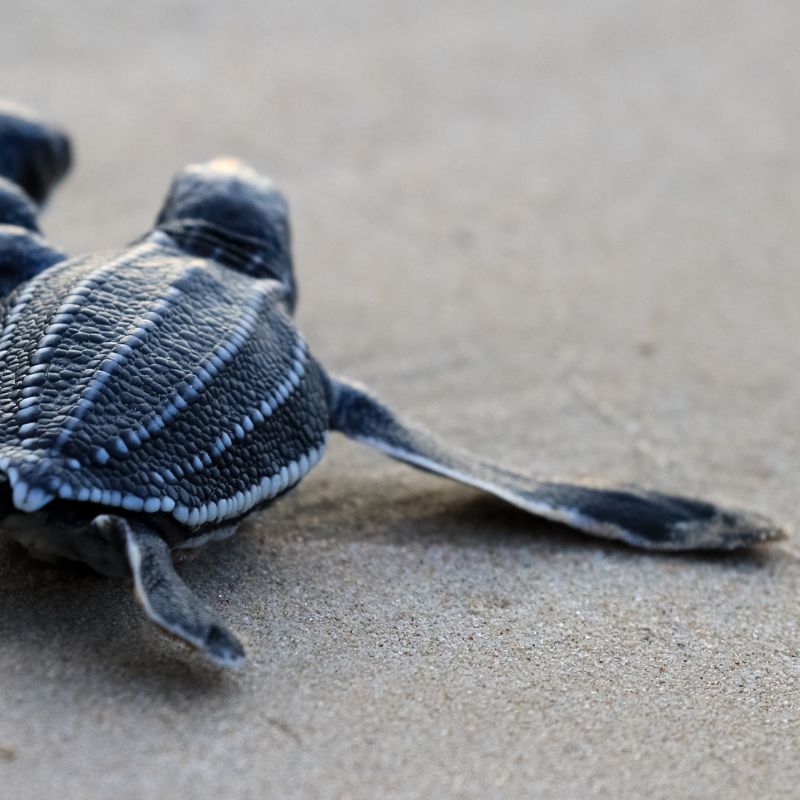

Family: Cheloniidae, Dermochelyidae Size: ~70–180 cm (2–6 ft) shell length Lifespan: ~50–80 years
Distribution: Oceans worldwide in warm tropical and subtropical waters (six of the seven species are found around U.S. coasts). Habitat: Marine environment – coastal waters, open ocean, coral reefs. Adult females return to sandy beaches to lay eggs.
Identification: Streamlined, flattened carapace; large flippers instead of feet for efficient swimming; cannot retract head into shell. Diet: Omnivorous or specialized by species – for example, green sea turtles eat mostly seagrass and algae, hawksbill turtles eat sponges, and leatherbacks feed on jellyfish. In general sea turtles consume a mix of marine plants and animals.
- Threats: Entanglement in fishing gear (bycatch), ingestion of plastic and marine debris, poaching of eggs and adults, habitat loss on nesting beaches, boat strikes, and climate change (which can alter sand temperatures and sex ratios of hatchlings).
- Conservation: All sea turtle species are protected under the U.S. Endangered Species Act and international agreements (e.g. CITES bans trade in turtle shell). Conservation efforts include protected nesting beaches, use of turtle excluder devices on fishing nets, and rescue programs for stranded or injured turtles. If you find an injured sea turtle in the U.S., contact NOAA’s marine wildlife authorities or a local sea turtle rescue hotline for assistance.
Land Tortoises (Testudinidae)


Family: Testudinidae Size: ~10–130 cm (4 in–4 ft) shell length Lifespan: ~50–100+ years
Distribution: Terrestrial environments on multiple continents – tortoises are found in North and South America, Africa, Asia, and Europe (Mediterranean). They are absent naturally from Australia. Habitat: Land-based habitats ranging from arid deserts and scrublands to savannas and tropical forests. Many tortoises dig burrows for shelter from extreme heat or cold.
Identification: High, domed carapace and sturdy scaled limbs. Tortoises have round, clawed feet (often compared to elephant feet) built for walking on land and digging, not swimming. They can withdraw into their shells for protection. Diet: Predominantly herbivorous. Wild tortoises graze on grasses, weeds, leafy greens, cactus pads, flowers and fallen fruits. (See What Do Tortoises Eat? for a detailed diet list.) A few tortoise species may opportunistically eat insects or carrion, but plant matter makes up the bulk of their diet.
- Threats: Habitat destruction and fragmentation (development, agriculture and wildfires), illegal collection for the pet trade, predation by invasive species (e.g. feral dogs or pigs preying on eggs and juveniles), and road mortality. Because tortoises reproduce slowly and take many years to mature, populations struggle to rebound from losses.
- Conservation: Many tortoise species are listed as vulnerable or endangered globally. Conservation measures include habitat preserves, breeding and reintroduction programs for critically endangered species, and strict regulations on trade (most are protected by laws and CITES permits). In the U.S., some tortoises like the desert tortoise (Gopherus agassizii) are federally protected. If you encounter an injured wild tortoise, contact a state wildlife rehabilitator or herpetological society for guidance – never place a tortoise in water, as they cannot swim.
Frequently Asked Questions
How can you tell a turtle from a tortoise?
There are a few simple ways to distinguish a land tortoise from an aquatic turtle:
- Location: Tortoises are found on land (often far from water bodies), whereas true turtles (like sea or pond turtles) spend most time in or near water.
- Feet or flippers: Look at the limbs. A tortoise has round, stumpy feet with claws for walking on land. An aquatic turtle has webbed feet or flippers adapted for swimming.
- Shell shape: Land tortoises usually have a high, dome-shaped shell. Water turtles have flatter, streamlined shells that glide through water more easily.
- Neck retraction: Most tortoises can pull their head and legs into their shell for defense. Sea turtles cannot retract into their shells at all (and many freshwater turtles only partially retract).
Are tortoises turtles?
Yes, in scientific terms tortoises are a subset of turtles. “Turtle” is a broad term for all reptiles in the order Testudines (which includes tortoises, sea turtles, freshwater turtles, terrapins, etc.). All tortoises belong to the turtle order, but not all turtles are tortoises. In common usage, people say “tortoise” to mean a land-dwelling turtle with a dome shell, and reserve “turtle” for those that spend time in water. So, while every tortoise is technically a turtle, if someone says “turtle” they usually mean the water-loving kind.
Can tortoises swim?
No – tortoises are land specialists and cannot swim. A tortoise will quickly sink in deep water because it lacks the adaptations that aquatic turtles have. Tortoises have heavy bodies and feet made for walking, not paddling. They may wade in very shallow water to drink or cool off, but they must avoid deep water. By contrast, sea turtles and many freshwater turtles are excellent swimmers thanks to their flippers or webbed feet and lighter, streamlined shells.
Can sea turtles hide in their shells?
No. Sea turtles cannot retract their head or flippers into their shells. Their bony shell structures are built for streamlining and strength, not for withdrawing body parts. The neck and limb anatomy of sea turtles doesn’t allow retraction, so they rely on their speed in water and tough shell for protection. Most land tortoises and freshwater turtles can pull in their head and legs to some extent, which helps shield them from predators on land – but sea turtles gave up that ability in exchange for a more hydrodynamic design suited to life in the ocean.
Which lives longer: sea turtles or tortoises?
Tortoises generally outlive sea turtles. Many tortoise species regularly live 80–100 years or more. Famous giant tortoises have reached 150+ years in age – the oldest on record is nearly 190 years old! Sea turtles are also long-lived (some may reach ages of 70–80 years in the wild), but they don’t typically match the extreme lifespans of the largest tortoises. Both animals have slow metabolism and life histories that give them longevity, but on average a land tortoise, especially a giant species, will live longer than a sea turtle.
Which is bigger, a sea turtle or a tortoise?
The largest sea turtle is bigger and heavier than the largest tortoise. The champion is the leatherback sea turtle (Dermochelys coriacea) – it can have a shell length up to about 2 m (6–7 ft) and weigh over 900 kg (~2,000 lbs). In comparison, the biggest tortoises (like the Aldabra giant tortoise, Aldabrachelys gigantea, or Galápagos tortoise) have shell lengths around 1.2–1.3 m (4 ft) and weigh up to 250–300 kg (~550–660 lbs). That said, most other sea turtle species (green, loggerhead, etc.) are smaller than the leatherback and fall in the 70–200 kg range, comparable to many medium-large tortoises. So, the leatherback turtle is the true giant, outsizing any tortoise, but if we compare a typical sea turtle to a giant tortoise, they can be of similar bulk.