
Turtles are unique reptiles defined by their shell – a living fortress fused to their skeleton. This guide breaks down turtle anatomy from the outside in, helping hobbyists and experts understand every part of a turtle’s body. By exploring the shell, organs, and adaptations, you’ll learn how a turtle’s anatomy equips it for survival.
The focus here is on turtle anatomy and the parts of a turtle, with examples from species common in the United States. We’ll cover the shell (carapace and plastron), external features like the head and limbs, and internal systems. Each section provides concise answers first – perfect for quick reference – followed by deeper insights.
Table of Contents
Overview
Answer: A turtle’s anatomy centers on its shell – a bony casing made of about 50–60 fused bones (ribs, spine, and others). The top shell is the carapace and the bottom is the plastron, joined at the sides by a bridge. Unlike a snail, a turtle can’t leave its shell; the shell is part of its skeleton and contains nerve endings and blood vessels. Inside, turtles have all major organs (heart, lungs, stomach, etc.) safely encased within this protective armor.
Turtles are reptiles (order Testudines) and are ectothermic (“cold-blooded”), relying on the environment to regulate body temperature. They have no teeth, but sharp keratin beaks for biting. They breathe air with lungs, but since their rigid shell prevents chest expansion, they use special muscles and movements to draw breath.
Turtles possess a three-chambered heart and a cloaca (a single rear opening) that serves both excretion and reproduction. Each adaptation – from the shell to the cloaca – reflects millions of years of evolution fine-tuning the turtle’s body for survival.
This labeled diagram shows a turtle’s anatomy from shell to organs. On the left, the bony shell (carapace on top, plastron underneath) is covered by patterned scutes. On the right, the internal organs fit within the shell: the lungs (white) are up near the top under the carapace, the heart (red) is mid-body, and the digestive tract (pink) winds through the abdomen. The turtle’s shoulder blades and hip bones sit inside the ribcage, which itself is fused to the shell.
External Anatomy
Answer: Externally, a turtle’s body has a few main parts: the shell (with an upper carapace and lower plastron), the head (with eyes, nostrils, and beak-like mouth), four limbs (legs or flippers with claws), and a tail (containing the cloacal opening). Each part serves specific functions – the shell protects and supports, the head houses sensory organs and feeding apparatus, the limbs enable walking or swimming, and the tail aids in balance and reproduction.
The primary external parts of a turtle include:
- Shell (Carapace & Plastron): The hard, bony outer shell consisting of a domed top (carapace) and a flat bottom (plastron).
- Head: Contains the brain, eyes, nose, and mouth. Turtles have no teeth, but a sharp beak instead.
- Limbs: Four legs (or flippers in sea turtles) with tough scales and usually claws, used for movement and digging.
- Tail: A short tail extending from the shell. The tail’s base holds the cloaca, the single exit for waste and reproductive fluids.
Below, we explore each of these external features in detail, highlighting their structure and purpose.
The Shell: Carapace and Plastron


The turtle’s shell is a remarkable structure – essentially a part of the turtle’s skeleton turned inside-out. The carapace (upper shell) and plastron (lower shell) are made of bone and cartilage, formed from fused ribs, vertebrae, and other bones. In most turtles, the two halves meet along the sides at a bony bridge, creating a rigid “shell box” around the body. Because the ribs and spine are fused to the shell, a turtle cannot crawl out of it – the shell grows with the turtle and is permanently attached.
The shell’s outer surface is usually covered by hard plates called scutes, made of keratin (the same protein in fingernails). These scutes overlap like shingles and protect the bony shell from scrapes and injury. Both the carapace and plastron have distinct scute patterns that help identify species. For example, most turtles have five central vertebral scutes down the middle of the carapace, flanked by four pairs of costal scutes, with ~11–12 pairs of marginal scutes around the edge.
The plastron typically has six pairs of scutes (gular, humeral, pectoral, abdominal, femoral, and anal). Some species even have a tiny single scute at the front of the carapace (a cervical or “nuchal” scute near the neck), and side-neck turtles (Pleurodires) have an extra intergular scute on the plastron.
| Carapace Scutes (top shell) | Plastron Scutes (bottom shell) |
|---|---|
| Vertebral – 5 center plates along the midline | Gular – front pair (near the turtle’s throat) |
| Costal (Pleural) – 4 pairs along each side of vertebrals | Humeral – pair behind the gulars |
| Marginal – ~11–12 pairs lining the shell edge | Pectoral – pair behind the humerals |
| Cervical (Nuchal) – 1 small scute at the front edge (present in some species) | Abdominal – large pair at the belly center |
| Femoral – pair toward rear, in front of tail region | |
| Anal – rearmost pair on the plastron |
Structurally, the shell is not just a hard cover – it’s alive and sensitive. There are nerves and blood supply in the shell’s bones and scutes, so a turtle can feel pressure or touch on its shell. A crack or break in the shell is painful and can bleed, much like a broken bone. This is why you must handle turtles gently: that tough exterior isn’t numb armor, but part of the turtle’s body.
Despite being rigid, shell shapes vary by habitat. Aquatic turtles usually have lower, streamlined shells for swimming, whereas tortoises have tall, dome-shaped shells for land protection. For instance, a sea turtle’s carapace is flatter to glide through water, while a box turtle’s high-domed shell allows it to enclose its limbs completely.
Some terrestrial turtles (like box turtles) even have a hinged plastron that can shut like a lid, offering full closure. In contrast, species like snapping turtles have a reduced plastron (small “cross-shaped” bottom) and cannot pull fully into their shell. They rely on their strong bite for defense instead.
Not all turtles have a hard scuted shell. Softshell turtles (Trionychidae) and the leatherback sea turtle lack keratin scutes – instead, their shells are covered with thick, leathery skin. The leatherback’s carapace is flexible with deep ridges and tiny bone pieces, an adaptation that allows it to dive to great depths without collapsing. These exceptions aside, the majority of turtles sport the classic hard shell made of bone and keratin.
Shell facts: The shell typically contains around 50 to 60 bones, including roughly 10 fused trunk vertebrae and the rib bones expanded and joined together. A turtle’s shoulder blades and pelvis are located inside the ribcage – an unusual trait (most animals have shoulder blades outside their ribs). The shell grows with the turtle; land turtles (tortoises) add growth rings to their scutes each year, which can give a rough estimate of age:. And importantly, a turtle absolutely cannot survive without its shell – the shell holds the turtle together and houses its organs, so a “shell-less turtle” is a myth (without the shell, the organs would be exposed and the turtle would perish).
Male vs female shells: In many species, males have a slightly concave (inward curved) plastron, while females have a flat or convex plastron. The concave plastron in males helps them mount females during mating. This difference isn’t extreme in all turtles, but it’s a useful clue in sexing some adult turtles. Females of some species also grow larger overall shells than males, providing extra room for egg carrying.
Head and Neck
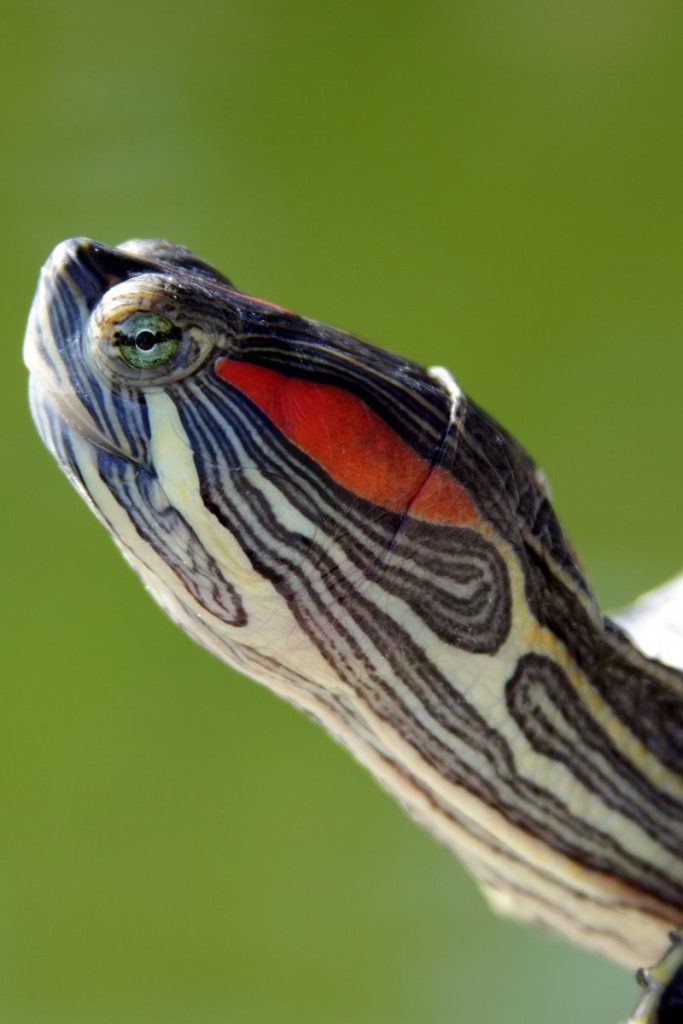

A turtle’s head contains its sensory organs and feeding structures. Notably, turtles do not have teeth. Instead, their jaws are equipped with hard, sharpened keratin edges forming a beak. This beak can slice through food – turtles bite and tear rather than chew extensively.(One quirk: baby turtles hatch with a small temporary “egg tooth” on the tip of the snout, used to break out of the egg, which falls off a few days after hatching.)
The shape of the beak varies by diet: carnivorous turtles have sharp, hooked beaks for tearing flesh, while herbivorous turtles have serrated ridge beaks to shred plants. Powerful biters like snapping turtles can deliver a formidable bite, even capable of amputating a finger in large species.
Turtles have well-developed vision and smell. Their eyes are positioned on the sides of the head (or more toward the top in aquatic species), giving them a wide field of view. Many turtles can see color; aquatic turtles, for example, are thought to be sensitive to reds and yellows which help them find food or mates. They also have nostrils at the tip of the snout and a keen sense of smell to locate food underwater or detect predators.
What about ears? Turtles do not have external ear flaps. Instead, they have internal ear structures and a tympanic membrane (eardrum) flush with the skin on each side of the head. As a result, their hearing is not as acute as mammals, but they are very attuned to vibrations. A turtle can detect low-frequency sounds and feel vibrations traveling through water or ground. This helps alert them to things like approaching predators or movement in the water. In essence, a turtle “hears” by sensing vibrations and changes in pressure more than by detecting airborne sound like we do.
The neck of a turtle is surprisingly flexible and plays a big role in how a turtle interacts with its environment. Most turtles can retract their head and neck into the shell for protection, but they do so in one of two ways: hidden-neck turtles (suborder Cryptodira) fold the neck in a vertical S-shape straight back into the shell, while side-neck turtles (suborder Pleurodira) bend the neck sideways to tuck the head under the shell’s rim.
In North America and most of the world’s turtles (cryptodires), you’ll see the head pull straight back with a quick motion – sometimes accompanied by a defensive hiss as air is expelled from the lungs. In side-neck turtles (found in places like South America, Africa, and Australia), the neck can’t retract fully; instead, the head is swung to the side and tucked alongside the shoulder under the shell. These different neck-folding methods are an important anatomical distinction among turtle families.
It’s important to note that not all turtles can withdraw into their shells. Sea turtles, for example, have non-retractable necks and heads – their bony shell structure and large flippers don’t allow it. Snapping turtles also have limited neck retraction (they often rely on lashing out to bite when threatened). But species like box turtles can pull in head, legs, and tail and close up completely, thanks to a hinged plastron. In any case, the neck’s mobility is vital for a turtle’s everyday tasks – from snagging food to grooming its shell.
Limbs and Claws


Turtles have four limbs, and their form mirrors the turtle’s lifestyle. Terrestrial turtles (tortoises) have sturdy, column-like legs with bent elbows and knees, designed to bear weight and walk on land. Their feet are often round and elephantine, with thick scales and short, strong claws. These heavy claws and legs allow tortoises to dig burrows and traverse rough ground.
They walk on their toes (tortoises are basically tip-toed walkers), which lifts their shell off the ground. In contrast, most freshwater turtles have somewhat webbed feet with long claws, letting them push through water and climb onto logs or riverbanks. They tend to walk flatter-footed when on land, compared to tortoises.
Sea turtles show the most extreme limb adaptation: their front legs have evolved into flippers. These flippers are elongated and paddle-like, with the “fingers” lengthened into fin bones and only a rudiment of claws (some sea turtles have one or two visible claws on their flippers, others have none).
The hind limbs of sea turtles are shorter, rudder-like flippers used for steering. With these powerful front flippers, sea turtles can “fly” through the water with strong, wing-like strokes. On land, however, they are clumsy; sea turtles cannot support their body weight well on their flippers, which is why they labor awkwardly when nesting on beaches.
Most semi-aquatic turtles (like pond and marsh turtles) have a mix of features – webbed feet for swimming, but also distinct toes with claws for climbing out of water and gripping logs. For example, a slider turtle or painted turtle has webbing between its toes but still has sharp claws. Those claws serve multiple purposes: digging nest holes (especially the females’ hind claws for nest digging, tearing apart food, and in males, sometimes clawing or gripping the female’s shell during mating.
An interesting internal twist is that a turtle’s limb girdles (the shoulder and hip bones) are located inside the ribcage. In other words, the turtle’s shoulder blades are beneath the shell, not on its back. This inside-out anatomy happened as the shell evolved – the ribs broadened and grew over the shoulder region. Despite this, turtles retain surprising mobility in their legs.
Many turtles can pull their legs almost completely inside their shell for protection, folding elbows and shoulders inward. Some species, like the Eastern box turtle, also have a hinge in the plastron that allows them to close up the limb openings once the legs are retracted, sealing themselves in like a “box.”
Tail and Cloaca
Turtles have a tail, though it’s usually short and often overlooked. The tail protrudes from the rear of the shell, below the junction of the carapace and plastron. In many species the tail is just a stubby appendage, but it plays an important role because of the cloaca at its base.
The cloaca is a multi-purpose opening under the tail – it’s the single exit for the digestive, urinary, and reproductive systems (essentially doing the jobs of anus and urethra). Both sexes excrete waste (feces and urine) through the cloaca, and it’s also where females lay eggs and males extend their reproductive organ.
Sex differences: The tail tends to be longer and thicker in males, since the male’s penis (yes, turtles have one penis) is housed inside the tail and extends through the cloaca during mating. The female’s tail is usually shorter and more slender, with the cloacal opening positioned closer to the shell’s edge. In males, the cloaca is positioned farther out toward the tip of the tail (when the tail is extended, it’s beyond the edge of the shell). These differences help experienced observers determine a turtle’s gender by tail size and cloacal location.
Turtle tails also have some fascinating adaptations. Aquatic turtles like painted turtles and sliders engage in “cloacal breathing” – essentially taking in water into the cloaca to absorb oxygen. Inside the cloaca are small sac-like bursa with many blood vessels, allowing some turtles to extract oxygen from water and stay submerged longer.
This doesn’t replace breathing with lungs, but it supplements it, acting like a built-in snorkel system. In cold water or during hibernation, species such as the Eastern painted turtle can survive for months by absorbing oxygen through the cloaca and throat linings. Because of this, these turtles have earned nicknames like “bum breather” – an amusing term for a serious adaptation!
Aside from respiration, the cloaca in water can also help with excretion of excess salts (in some aquatic species) and picking up chemical cues in the environment. When not in use, a turtle’s tail is often held straight out or tucked to the side. It can aid balance, especially for males when coupling or for turtles climbing awkward terrain. Some male turtles (like giant tortoises) even use their tails to fan scents or pheromones toward females during courtship. Generally, though, the tail’s most critical function is housing the cloacal vent – a small but vital piece of the turtle’s anatomy puzzle.
Internal Anatomy


Answer: Inside their shell, turtles have the same major organ systems as other vertebrates, just configured to fit within a compact bony dome. They have a spine and ribcage (fused to the shell), a three-chambered heart, two lungs, a full digestive tract, liver, kidneys, and so on. The rigid shell means turtles evolved special ways to breathe (since they can’t expand their chest), and their organs are often flattened to spread under the carapace. But overall, a turtle’s internal anatomy includes everything it needs for life: circulatory, respiratory, digestive, nervous, and reproductive systems, all neatly packed in its shell.
To see what’s inside a turtle, imagine lifting the top shell off (don’t try this – it would harm the turtle!). Directly under the carapace lie the lungs – large, spongy organs up near the top of the shell. The turtle’s heart is usually located slightly forward of center, tucked between the lungs and liver. The liver itself is one of the largest internal organs, often reddish-brown and spanning much of the side.
The stomach is up front on the turtle’s left side, leading into intestines that loop around, processing food. Kidneys are toward the back, and the urinary bladder sits near the tail end, connecting to the cloaca. Female turtles have a pair of ovaries and oviducts (which carry eggs), while males have testes internal near the kidneys and an extendable penis within the tail/cloaca area.
All these organs are compactly arranged and somewhat flattened to fit the low profile of the shell. Notably, turtles don’t have a diaphragm muscle – instead, they move their internal muscles and limbs to help pump air in and out of the lungs. Their heart has three chambers (two atria and one ventricle partially divided by a septum).
This configuration, common to non-crocodilian reptiles, allows some shunting of blood; it’s efficient for an animal that can hold its breath for long periods. Turtles can tolerate low oxygen levels in their blood remarkably well – one reason they can remain underwater or hibernate without breathing for extended times.
Inside the shell, every organ is in fixed position (there’s no room for expanding or contracting like in mammals). So, when a turtle pulls its head or limbs in, it actually has to exhale some air to make space, which is why a startled turtle often hisses (that’s the sound of air being expelled from the lungs). Likewise, a very full stomach or a gravid female with eggs takes up space and can press on the lungs, so turtles have to adjust their breathing and buoyancy accordingly. The internal anatomy is a game of balancing acts within the shell’s confines.
Here’s a breakdown of the major internal organs and their roles:
Lungs: Two sponge-like lungs attached under the carapace, used for breathing air. Turtles inhale by contracting muscles since they lack a diaphragm, and some species can also absorb oxygen through the throat or cloaca when underwater.
Heart: A three-chambered heart (two atria, one ventricle) located mid-body. It pumps blood to circulate oxygen and nutrients. The single ventricle has partial divisions that help separate oxygen-rich and oxygen-poor blood.
Liver: A large organ that filters blood and produces bile for digestion. It lies toward the front, often spanning both sides of the body cavity.
Stomach: A muscular sack on the left side where food is first broken down. It connects the esophagus (from the mouth) to the intestines.
Intestines: A long, coiled tube where most digestion and nutrient absorption occurs. Turtles have relatively long intestines; herbivorous species have even longer guts to digest fibrous plants.
Pancreas: A gland tucked in the loop of the intestines that produces digestive enzymes and hormones (like insulin) to regulate blood sugar.
Kidneys: Two bean-shaped organs near the back that filter waste from the blood. They produce urine, which flows to the bladder.
Bladder: A sac that stores urine. Turtles (unlike most birds or snakes) have a urinary bladder, allowing them to reabsorb water – an adaptation especially useful in dry environments.
Reproductive organs: In females, paired ovaries and oviducts (where eggs are formed and passed to the cloaca). In males, internal testes and a single penis that everts through the cloaca for mating.
Cloaca: The chamber at the base of the tail receiving waste from the intestines (via the rectum) and bladder, as well as eggs or sperm from the reproductive tract. It opens externally for elimination of wastes or laying eggs.
All these organs are packed within the bony shell. The arrangement is efficient – a turtle’s metabolism is generally slow, and there’s little waste of space. During brumation (reptile hibernation) in winter, a turtle’s heart rate and metabolism slow dramatically, and it can survive on stored energy and cloacal respiration for months. Conversely, when active in warm conditions, the turtle’s internal organs work in concert to power its daily activities – pumping blood, digesting food, and so on.
Skeleton: The turtle’s internal skeleton is unusual because of the shell. The spine (vertebral column) runs along the center of the carapace, fused to it. The ribs are broadened and also fused into the carapace bones. The shell, in effect, replaces the typical ribcage. The neck vertebrae (usually 8) are flexible and not attached to the shell, allowing neck movement. The tail has a series of caudal vertebrae (the number varies by species – long-tailed turtles have more).
The shoulder girdle (scapula, coracoid, etc.) and pelvic girdle (hips) sit inside the shell, braced against the shell bones. Limb bones include a humerus in each front leg and femur in each hind leg, with elbow and knee joints, and the usual array of smaller bones down to phalanges (toe bones). Despite the odd configuration, a turtle’s skeletal layout has all the parts you’d expect in a four-legged vertebrate – they’re just arranged in a turtle-specific way.
Nervous system: The turtle’s brain is relatively small (about the size of a walnut in a medium turtle) and is located in the skull. It controls vital functions and behavior. A spinal cord runs through the vertebrae. Turtles have the same five senses as we do (sight, smell, hearing, taste, touch), though with varying acuity. The brain’s structure reflects their simpler lifestyle.
For instance, the parts for instinctual behavior and sensory processing are well-developed, whereas problem-solving parts are smaller. Interestingly, turtles can feel through their skin and shell (via nerves in the shell and peripheral nerves in the skin). They also show long-term memory, especially when it comes to navigation and seasonal routines (like remembering nesting beaches or good feeding spots).
In summary, the inside of a turtle is a compact package: every organ and bone has its place within the shell. This internal anatomy is tightly linked to the external anatomy – for example, the hard shell protects the soft organs, and the unusual breathing mechanism is a direct result of having a fused ribcage. Understanding this layout not only satisfies curiosity about “what’s inside the shell,” but also explains why turtles are built the way they are and how they live such long, slow-paced lives.
Glossary of Turtle Anatomy Terms
This glossary explains key anatomical terms and concepts related to turtles:
Carapace: The top (dorsal) part of a turtle’s shell. Usually domed and covered in scutes, it’s formed from fused ribs and vertebrae.
Plastron: The bottom (ventral) part of the shell, covering the turtle’s belly. In some species the plastron has hinges that allow it to close up.
Bridge: The side bony connection where the carapace and plastron meet. The bridge is part of the shell that unites top and bottom halves along the turtle’s sides.
Scutes: The keratin scales or plates covering the shell bones. Scutes protect the shell and give it a distinct pattern (e.g. vertebral, costal, marginal scutes).
Keratin: A hard protein that makes up turtle scutes, as well as reptile scales, bird beaks, and human nails and hair.
Cloaca: A common chamber at the base of the tail that receives waste from the intestines and bladder and reproductive material (eggs or sperm). It opens to the outside for excretion or egg-laying.
Cloacal Respiration: A method of breathing where some aquatic turtles take water in and out of the cloaca to absorb oxygen through specialized sacs (bursae). It allows prolonged underwater stays.
Ectothermic: Cold-blooded. Turtles are ectotherms, meaning they rely on external heat sources (sun, warm water) to regulate body temperature rather than generating significant body heat internally.
Cryptodira (Hidden-neck): The suborder of turtles that retract their neck straight back into the shell. These include most turtles and tortoises worldwide (e.g. pond turtles, snapping turtles, tortoises).
Pleurodira (Side-neck): The suborder of turtles that fold their neck sideways under the shell. Found in the Southern Hemisphere (e.g. Australian snake-neck turtles, South American side-necks). They cannot pull the head fully inside the shell.
Nuchal Scute: Also called the cervical scute. A small scute at the front center of the carapace (near the neck) present in some species. Not all turtles have a nuchal scute; when present, it’s a single plate at the carapace’s edge above the head.
Intergular Scute: An extra scute found on the plastron of side-neck turtles (pleurodires). It lies between the gular scutes, at the front of the plastron, and is absent in most other turtles.
Hinged Plastron: A plastron that has a joint (hinge) allowing it to move. For example, box turtles have a hinged plastron that can close the front (and sometimes rear) openings of the shell like a trapdoor.
Three-Chambered Heart: The reptilian heart structure turtles have – consisting of two atria and one ventricle (partially divided). It allows some mixing of oxygenated and deoxygenated blood, but turtles can direct blood flow dynamically, which is useful during diving or apnea.
Testudines: The scientific order name for all turtles, tortoises, and terrapins. It encompasses all modern turtle species. (Sometimes Chelonia is used synonymously.)
Oviparous: Egg-laying. All turtles are oviparous – females dig nests and lay eggs, from which baby turtles (hatchlings) emerge after incubation.
Egg Tooth (Caruncle): A temporary tooth-like structure on a hatchling turtle’s snout used to slice open the egg shell. It falls off shortly after the turtle hatches.
Sexual Dimorphism: Physical differences between males and females of a species. In turtles, common dimorphisms include tail length (males often have longer tails), plastron shape (males concave, females flat), size (females of aquatic turtles often larger), and claw length (e.g. male slider turtles have very long foreclaws).
Frequently Asked Questions
Can a turtle live without its shell?
No – a turtle absolutely cannot survive without its shell. The shell is not like a hermit crab’s borrowed shell; it’s part of the turtle’s body (fused bones, with nerves and blood supply). Removing a turtle’s shell would be fatal, as the shell holds the muscles and organs in place. If a shell is damaged, it’s very painful and can bleed. In short, a turtle and its shell are one unit for life – the shell grows with the turtle and protects its vital organs. A turtle “out of its shell” is a creature that doesn’t exist (except in cartoons).
Do turtles have teeth?
No, turtles do not have teeth. Instead, they have a hard, sharpened beak made of keratin. This beak functions like a pair of serrated pincers or knife blades. Carnivorous turtles have sharp hooked beaks to tear meat, while herbivorous turtles have ridged beaks to cut plants. Baby turtles hatch with a tiny egg tooth (or “hatching tooth”) to break out of the egg, but this falls off soon after. So, while turtles lack true teeth, their tough beaks do the job of biting and slicing food very effectively. In fact, a large snapping turtle’s bite can cut through flesh or even break small bones – no teeth needed!
Can turtles feel pain through their shell?
Yes. Turtles can feel touch and pain through their shells. The shell has nerves and a blood supply, so it’s sensitive to pressure, bumps, and injuries. If you gently scratch a turtle’s shell, the turtle can feel it – some turtles even seem to enjoy shell rubs. Conversely, a crack or drill into the shell is painful and can bleed. The shell is made of living bone overlain by keratin, so while it’s tough, it’s not insensate. Think of it like a fingernail – you can feel pressure on it, and damage to the nail bed hurts. Similarly, turtles feel through their shell, which is why you should never tap or hit a turtle’s shell. Treat it as you would the turtle’s skin.
Can turtles breathe underwater (do they have gills)?
Turtles do not have gills – they have lungs and breathe air, so they must surface to take breaths. However, some aquatic turtles can stay underwater for a very long time by absorbing oxygen in other ways. They don’t breathe water like fish, but they can do gas exchange through the linings of their throat or cloaca (cloacal respiration).
For example, a painted turtle or musk turtle can sit on the bottom and get enough oxygen through water pumping in and out of its throat and cloaca to remain submerged for hours or even months in cold weather. But eventually, every turtle needs to come up for real air.
No adult turtles have true gills. So while turtles are excellent at holding their breath and using “auxiliary” respiration, they still rely on lungs and must breathe air periodically. Young hatchlings of some species (like certain musk turtles) have been noted to have very fine papillae in their throat that function a bit like internal gills, but these are supplemental. Bottom line: turtles are air-breathers, not fish, even though they’re great at making a single breath last a long time.
What is the difference between a turtle and a tortoise?
All tortoises are turtles, but not all turtles are tortoises. In everyday usage, “turtle” usually refers to water-dwelling species (including sea turtles and pond turtles), whereas “tortoise” refers to land-dwelling turtles. There are some key anatomical and lifestyle differences:
Habitat: Tortoises live on land and are not adapted for swimming. Turtles (in the general sense) often live in water (oceans, rivers, swamps) or at least spend much of their time in water.
Shell shape: Tortoises have high, domed shells that are heavier – good for protection on land. Aquatic turtles have flatter, streamlined shells that create less drag in water. Sea turtles have very sleek shells for efficient swimming.
Limbs: Tortoise limbs are elephant-like with thick, rough legs for walking on land, and they lack webbing. Aquatic turtles have webbed feet or flippers. For example, box turtles and tortoises have stumpy feet with claws, while a pond turtle has webbed toes, and a sea turtle has flippers.
Diet: Many tortoises are herbivores, eating plants, whereas aquatic turtles tend to be omnivores or carnivores (catching fish, insects, etc.). Their mouthparts reflect this: tortoises have serrated beaks for plants, water turtles often have sharper beaks for snaring prey.
Lifespan: Tortoises often live very long lives (50–100+ years in some giant tortoises). Aquatic turtles also can be long-lived, but generally tortoises take the prize for longevity.
From a scientific perspective, both tortoises and water turtles belong to the turtle order Testudines. “Tortoise” usually denotes members of the family Testudinidae (true land tortoises), whereas “turtle” can refer broadly to any in the order, or specifically to aquatic types.
In the US, people say “turtle” for water species and “tortoise” for land, but in some other English-speaking regions, all are called “turtles.” The distinctions above cover the general differences. So if it has chunky feet and a dome shell, you’re likely looking at a tortoise. If it’s sleek with webbed feet or flippers, it’s a turtle (or terrapin) adapted to water.
How can you tell if a turtle is male or female?
Several clues can indicate a turtle’s sex, but it varies by species. Common gender differences include:
Tail size and cloaca position: Males generally have longer, thicker tails, and the cloacal opening (vent) is farther out toward the tip of the tail. Females have shorter, thinner tails with the vent closer to the shell’s base.
Plastron shape: In many species, males have a concave (inward-curved) plastron, which helps them mount the female’s shell during mating. Females’ plastrons are flat or slightly convex to accommodate carrying eggs.
Size: Females are often larger in aquatic turtles (to carry more eggs), whereas in tortoises it can vary. For example, female red-eared sliders usually outgrow males; female snapping turtles tend to be bigger too.
Claw length: In certain species like sliders and map turtles, males have very long front claws, which they use in courtship (fluttering them around the female’s head). Females’ claws are shorter.
Other traits: Some species have color differences (male box turtles may have brighter eye colors or head markings). Male tortoises of some species have more elongated gular scutes (projections under the neck) used for combat.
It’s best to use a combination of these traits rather than a single feature, as there are exceptions. Juvenile turtles are hard to sex – these differences become apparent only in adults. If you see a turtle with a big thick tail and a rear vent past the shell edge, it’s likely male.
A turtle with a tiny tail and vent right at the shell rim is likely female. The concave vs. flat plastron is a handy test in tortoises and many freshwater turtles. These gender clues are very useful for breeders or hobbyists trying to pair turtles, and for conservationists monitoring wild populations.
How can you tell a turtle’s age?
Estimating a turtle’s age is tricky and usually imprecise. One commonly used method is counting the growth rings on the scutes of the shell. Each year, as a turtle grows, a new ring may form on its scutes (especially in tortoises and some box turtles). By counting the visible rings, you can get a rough idea of age – for example, 10 rings might indicate ~10 years.
However, this is not foolproof: turtles in the wild don’t always lay down clear annual rings (growth depends on food availability and climate, so they might grow multiple small rings in a good year or hardly any in a bad year). Older turtles’ scutes may wear smooth, erasing rings. Another clue can be overall size relative to known growth rates for that species, though individual growth can vary a lot.
In young turtles, you can sometimes estimate age within the first few years by rings or size. But once a turtle is mature, age becomes mostly a guess unless you know its hatch date. Some long-lived turtles like sea turtles and large tortoises are aged by mark and recapture studies or by known history (for example, a tortoise in a zoo with records spanning decades).
In summary, scute rings give a ballpark figure when applicable, but they’re not like tree rings – not 100% reliable. A very smooth-shelled turtle could be quite old, and a well-fed captive turtle might have extra ring lines that are misleading. So, any age estimate should be taken as an approximation. Turtles, especially pet turtles, often outlive their owners’ expectations – it’s better to think in terms of life stages (juvenile, subadult, adult) rather than exact years.
Sources
- Ontario Turtle Conservation Centre – Some Interesting Turtle Facts (2018)
- San Diego Zoo – Turtle and Tortoise: Anatomy and Facts
- Encyclopædia Britannica – Turtle Overview & Anatomy (Smithsonian Institution contributions)
- NOAA Fisheries – Leatherback Sea Turtle Species Profile (largest turtle, unique shell)
- IUCN Tortoise and Freshwater Turtle Specialist Group – Conservation & Anatomy Resources