
Turtles have a reputation for being slow, but how fast can a turtle run when it really tries? In this guide, we explore turtle speed on land and in water, debunk myths, and compare different species. You’ll learn surprising facts about how quick turtles and tortoises can move and how to help them stay safe.
This comprehensive guide focuses on turtle speeds in the United States. It covers how fast various turtles and tortoises run or swim, factors that affect their pace, and what their movement means for their survival. Whether you’re a curious hobbyist or a seasoned herpetology enthusiast, read on for turtle speed charts, species profiles, and FAQs.
Table of Contents
Overview
How fast can a turtle run? On land, most turtles plod along at a slow walking pace, around 0.5 to 1 mph (0.8-1.6 km/h). The quickest turtles on land, like softshell turtles, can sprint up to about 3 mph (5 km/h) in short bursts. That’s about as fast as a human walking briskly. In contrast, turtles are much faster in water. Aquatic turtles regularly swim at 1-6 mph (1.6-9.6 km/h) and can hit top speeds around 22 mph (35 km/h) when fleeing danger. In water, a determined sea turtle can easily outpace a human swimmer.
Turtles are built for steady movement and protection, not speed. Their hard shells and short legs mean they can’t run like a rabbit. However, when motivated, such as avoiding predators or searching for mates, turtles can move faster than many people expect. Generally, turtles (aquatic species) are quicker than tortoises (land-dwelling species). Tortoises are the slowpokes of the turtle world, often averaging just 0.2-0.5 mph (0.3-0.8 km/h) at best. Even the fastest tortoise on record clocked in at only 0.6 mph (1.0 km/h), a crawl compared to most turtles.
Turtles also swim far faster than they walk. With webbed feet or flippers and a streamlined shape, aquatic turtles zip through water roughly 3-4 times faster than they trudge on land. A marine turtle like the leatherback sea turtle, for example, can cruise around 5-10 mph (8-16 km/h) underwater and briefly sprint at over 20 mph when alarmed. On land, that same leatherback can only lumber from nest to sea at a fraction of that speed.
Below is a comparison of speeds for different types of turtles and tortoises, showing their estimated top land and water speeds. It highlights how much turtle speeds can vary by species and environment.
| Species | Land Speed (km/h, mph) | Water Speed (km/h, mph) |
|---|---|---|
| Leatherback Sea Turtle | ~1 km/h (0.6 mph) | 35 km/h (22 mph) |
| Common Snapping Turtle | up to 6 km/h (4 mph) | 16 km/h (10 mph) |
| Florida Softshell Turtle | up to 5 km/h (3 mph) | ~10 km/h (6 mph) |
| Gopher Tortoise | 0.3 km/h (0.2 mph) | N/A (land only) |
As you can see, a speedy softshell or snapping turtle can outrun other turtles on land, but even they move at jogging pace. In water, sea turtles are clear winners. A leatherback sea turtle gliding through the ocean leaves any tortoise far behind. Understanding these speed differences helps dispel the myth that “all turtles are equally slow.” In reality, it depends on the species and whether they’re on land or in water.
Myth vs. Fact – Turtle Speed:
Myth: “Turtles are the slowest animals.” – Fact: Turtles are slow on land, but not the slowest. Many tortoises walk at 0.2 mph, yet a common garden snail creeps at about 0.03 mph. Some turtles swim at 10+ mph, far faster than a human swimmer.
Myth: “Turtles can’t run at all.” – Fact: When frightened or excited, turtles can hustle. Softshell turtles have been observed running (in their turtle way) around 3 mph on land to reach water or cover.
Myth: “All turtles move at the same slow speed.” – Fact: Speed varies widely by species. Sea turtles and softshells are relatively quick, whereas box turtles and giant tortoises are much slower.
Myth: “Turtles are just as slow in water as on land.” – Fact: Aquatic turtles are much faster swimmers. An average turtle swims 3-4 times faster than it walks. In their aquatic element, turtles can be surprisingly agile and quick.
Turtles evolved to prioritize defense over sprinting. Their heavy shells and sprawling gait mean they won’t be winning any races against rabbits. But speed isn’t vital for their survival strategy. Instead, turtles rely on their shell for protection and patience to outlast predators or wait for opportunities. Sea turtles developed flippers to roam oceans swiftly, while land tortoises carry their homes and move deliberately between burrows and grazing spots. Each species has the right speed for its lifestyle.
In the sections below, we profile some specific turtles and tortoises to see how fast each kind can move. We also answer frequently asked questions, including how turtles compare to humans and what to do if you find a turtle crossing the road.
Species Profiles
Leatherback Sea Turtle (Dermochelys coriacea)


Family: Dermochelyidae
Size: Up to 180 cm (6 ft) length
Lifespan: 50+ years (estimated)
Distribution: Found in tropical and temperate oceans worldwide, including the Atlantic and Pacific coasts of the U.S.
Habitat: Pelagic (open ocean) environments; leatherbacks roam the high seas and come ashore only on sandy tropical beaches to nest.
Identification: The leatherback is the largest turtle on Earth. It has a black, leathery shell with seven long ridges and no hard scales. Instead of typical bony plates, its carapace is flexible and rubbery, adapting it for deep dives. Front flippers are long (up to 2.5 m span) and paddle-like, enabling powerful swimming. Diet: Mostly jellyfish and other soft-bodied ocean animals. A leatherback can consume its weight in jellyfish in a day, using sharp cusp-like jaws to snag slippery prey.
Threats: Entanglement in fishing gear (nets, lines) and ingestion of plastic waste are major causes of injury and death. Leatherbacks often mistake floating plastic bags for jellyfish. Egg poaching and loss of nesting beaches to coastal development also threaten their numbers. Climate change (warming sands) can affect hatchling sex ratios and survival.
Conservation: Listed as endangered under the U.S. Endangered Species Act and globally Vulnerable by IUCN. International efforts protect leatherbacks: key nesting beaches are monitored, and fisheries employ turtle-excluder devices. Conservation groups work to reduce ocean plastic and light pollution near nesting sites. Many countries strictly ban harvesting eggs or turtles. Leatherbacks remain rare but protected, with around 35,000-65,000 nesting females estimated worldwide.
Florida Softshell Turtle (Apalone ferox)


Family: Trionychidae
Size: Females up to 76 cm (30 in); Males smaller (35 cm / 14 in)
Lifespan: 20-30+ years
Distribution: Southeastern United States, mainly Florida and parts of Georgia, South Carolina, and Alabama. Common in Florida’s wetlands statewide.
Habitat: Shallow freshwater bodies, ponds, lakes, swamps, and slow-moving rivers with soft, sandy or muddy bottoms. Prefers warm, calm waters with abundant vegetation. Can tolerate short trips on land between water bodies, especially in rainy seasons.
Identification: A large aquatic turtle with a flat, pancake-like body and a leathery, flexible shell (no hard scutes). Color is brown or olive with dark blotches, and the plastron (belly) is whitish. The softshell has a distinctive long neck and snorkel-like nose, which it uses to breathe while mostly submerged. Its feet are fully webbed, ideal for quick swimming.
Diet: Carnivorous. It ambushes fish, frogs, crayfish, insects, and even the occasional duckling. Softshell turtles lie buried in mud, then lunge with a rapid strike to catch prey, demonstrating quick reflexes in water.
Threats: Habitat loss from wetland drainage and development is a primary threat. Road mortality is common when softshells wander overland (often females seeking nesting sites). They are also subject to hunting and over-collection; softshell turtles have been harvested for food and the pet trade. Predators like raccoons and alligators prey on eggs and juveniles. Pollution and poor water quality can harm their prey base and health.
Conservation: The Florida softshell is not currently endangered (IUCN Least Concern) and remains relatively abundant. Harvest and transport are regulated in states like Florida to prevent overexploitation. Conservation efforts focus on protecting wetlands and nesting habitats. Public education helps reduce road kills (e.g., signage in high turtle-crossing areas). As a native species, it is illegal to commercially harvest softshell turtles in some states, and bag limits apply. Maintaining clean, connected waterways is key to this species’ ongoing health.
Common Snapping Turtle (Chelydra serpentina)

Family: Chelydridae
Size: Shell length 20-50 cm (8-20 in); weight 10-16 kg (22-35 lbs) typical
Lifespan: 30-50 years
Distribution: Widespread across the eastern and central United States (found in 40+ states), extending into southern Canada. Also introduced in some western states and other countries (where considered invasive).
Habitat: Prefer permanent freshwater bodies like ponds, marshes, swamps, slow rivers, and lakes. Snapping turtles thrive in muddy, vegetated waters. They rarely leave the water except females laying eggs on land in late spring to summer. Can tolerate brackish water in tidal estuaries too.
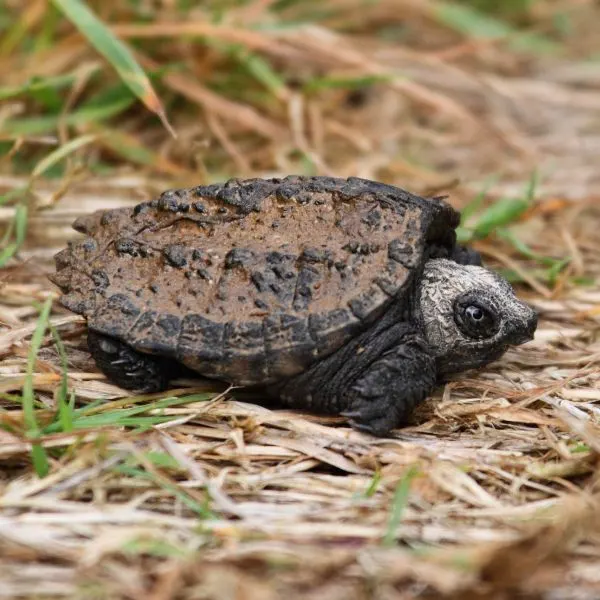
Identification: A large freshwater turtle with a heavy, rough shell and powerful build. The carapace is brown to black with a serrated rear edge and often covered in algae. The head is large with a hooked beak and strong jaw muscles. Snappers have long, muscular tails with saw-tooth spines running along the top. They cannot fully retract into their shell, so they rely on their fierce demeanor for defense.
Diet: Omnivorous and opportunistic. Common snappers eat fish, frogs, tadpoles, aquatic insects, snails, and even ducks or small mammals if they can catch them. They also scavenge carrion. Plant matter like algae and lily pads makes up a smaller portion of the diet. They often lie in wait under water and snap up prey with lightning-fast head strikes.
Threats: Generally hardy with few natural predators once grown (alligators or large carnivores occasionally take them). The main threats are human-related: habitat destruction (wetland draining, pollution) and road mortality during nesting season. In some areas, people persecute snapping turtles due to fear or because they prey on game fish or waterfowl. They are also harvested in certain regions for meat (turtle soup), which can impact local populations if unregulated. Egg and hatchling predation by raccoons, skunks, and foxes can be high.
Conservation: Common snapping turtles are not endangered and are considered locally common across much of their range. They are listed as Least Concern (where assessed) and tolerate human-altered environments fairly well. Many states have regulations on snapper harvesting (seasonal limits or permits) to prevent overharvest.
Public awareness campaigns emphasize not killing snapping turtles on sight. Despite their snap, they are important scavengers in aquatic ecosystems. Creating safe crossings or nesting areas away from roads can help reduce female mortality. Overall, the species is secure, but ongoing wetland conservation ensures they remain a thriving part of their native habitats.
Gopher Tortoise (Gopherus polyphemus)


Family: Testudinidae
Size: 23-28 cm (9-11 in) shell length
Lifespan: 40-60 years (in wild)
Distribution: Southeastern United States, primarily in Florida and coastal areas of Georgia, Alabama, Mississippi, and Louisiana. The gopher tortoise’s range roughly mirrors the coastal plain and sandhill regions with warm climates.
Habitat: Dry upland areas with well-drained sandy soils. Common habitats include longleaf pine forests, oak-sandhills, scrub, and coastal dunes. They require habitat where they can dig deep burrows. Open canopy and plenty of low vegetation (grasses and forbs) are ideal, as these tortoises are grazers. Many gopher tortoise habitats are fire-maintained ecosystems (fire keeps vegetation open and suitable).
Identification: A medium-sized land tortoise with a broad, domed brown or gray shell and stumpy, elephantine legs. Forelimbs are shovel-like with thick scales, perfectly adapted for digging burrows. The head is broad and covered in protective scales. Gopher tortoises have strong, scaly front legs that act as spades; they dig burrows averaging 15-20 feet long which provide shelter for themselves and many other species.
Diet: Herbivorous. They feed on a variety of grasses, herbs, wildflowers, and fruits found in their native scrub and pine flatwoods. Wiregrass, broadleaf grasses, legumes, and prickly pear cactus are favorites. They emerge from burrows to forage, especially in mornings or late afternoons, moving slowly from plant to plant.
Threats: The biggest threat is habitat loss. Development, agriculture, and forestry practices have greatly reduced the longleaf pine savannas and scrublands that gopher tortoises need. When land is cleared for construction, tortoises can be crushed or buried if burrows are not identified and the animals relocated. They also face road mortality when crossing between fragmented habitats.
Additionally, gopher tortoises were historically hunted for food (“gopher stew”) in some areas. Predators like raccoons and foxes frequently dig up tortoise nests, eating eggs and hatchlings. Disease such as an upper respiratory tract disease has impacted some populations as well.
Conservation: The gopher tortoise is a protected species throughout its range. It is listed as threatened in most states (and a candidate for federal threatened status in the eastern part of its range). Many states require permits to relocate gopher tortoises from development sites to designated preserves rather than allowing them to be harmed.
Conservation groups and wildlife agencies actively manage gopher tortoise habitat by preserving land and using controlled burns to maintain the open ecosystems these tortoises need. The species is considered a keystone species because its burrows provide shelter for hundreds of other creatures. Protecting gopher tortoises has a broad benefit for overall biodiversity in their habitat. With ongoing efforts, some populations are stabilizing, but the species remains Vulnerable (IUCN) due to continuing habitat pressures.
Frequently Asked Questions


What is the fastest turtle in the world?
The fastest turtle on record is the leatherback sea turtle. In water, a leatherback can reach burst speeds up to about 22 miles per hour (35 km/h). No other turtle or tortoise comes close to this velocity under its own power. On land, however, leatherbacks are slow crawlers.
If we consider land speed only, some of the fastest running turtles are likely softshell turtles, which can run around 3-4 mph (5-6.5 km/h) in short spurts. Among tortoises (which are turtles in the broad sense), the fastest recorded is a leopard tortoise named Bertie that ran 0.63 mph (1.0 km/h) to earn a Guinness World Record. In summary: the leatherback is the quickest turtle in water, while speedy softshells or box turtles hold the title on land, and tortoises lag behind.
Are turtles faster than tortoises?
Yes, in general aquatic turtles are faster than tortoises. “Turtle” can refer to all chelonians, but typically turtles (especially water turtles) are built for at least some speed and agility in water, whereas tortoises are strictly land-dwellers with heavy shells and columnar legs for slow, steady movement. A turtle like a red-eared slider or a sea turtle can swim and even walk faster than a tortoise.
For example, a cooter (aquatic turtle) was measured at about 1.1 mph (1.7 km/h) on land, which is faster than most tortoises. Meanwhile, tortoises like the gopher tortoise amble around 0.2 mph (0.3 km/h) on average. The difference comes from anatomy and lifestyle: turtles often have webbed feet or flippers and less weight relative to their size, allowing quicker motion, especially in water.
Tortoises have stout legs for digging and supporting large shells, so they move with slow but enduring effort. In a race on land, nearly any water turtle would beat a tortoise. In water, tortoises can’t compete at all (they can’t swim, whereas aquatic turtles excel at swimming). So, turtles definitely outpace tortoises in most scenarios.
How fast can sea turtles swim?
Sea turtles are much faster swimmers than they appear. Most sea turtles cruise at modest speeds of around 1.5 to 6 mph (2.5-10 km/h) during routine travel. When they need to, they can accelerate significantly. The cruising speed for a green sea turtle, for instance, might be 2-3 mph, but a startled green or loggerhead sea turtle can surge at over 15 mph in short bursts.
The champion sprinter is the leatherback sea turtle, which has been recorded at 22 mph (35 km/h) while fleeing (this is the top speed for any reptile in water). To put it in perspective, 22 mph in water is incredibly fast, faster than many fish. However, sea turtles cannot maintain such speeds for long distances. Over long migrations, they swim more slowly and steadily.
For example, leatherbacks often average about 5-6 mph (8-10 km/h) during long-distance travel. Still, if you drop into the ocean with a sea turtle, don’t expect to keep up; even their relaxed swim is typically quicker than a human’s swimming speed.
Can a turtle outrun a human?
On land, no, even a fast turtle is much slower than an average human. The quickest turtle on land (perhaps a softshell or a motivated box turtle) tops out around 3-4 mph. By contrast, humans walk about 3 mph and can run well over 10 mph. Even an unathletic person can easily outrun the fastest turtle over land. However, in water it’s a different story. Humans are relatively slow swimmers (most swim under 5 mph; Olympic champion Michael Phelps swims around 6 mph).
A sea turtle swimming at top speed (10+ mph) would “out-swim” any human. For example, a large snapping turtle can swim 8-10 mph, which already beats a human swimmer. A leatherback could literally swim circles around a person. So, while no turtle can chase down a running human on foot, in the ocean a human would have no chance of catching up to a fleeing turtle.
It’s also worth noting that turtles don’t chase humans. If anything, a turtle will either ignore you or try to escape. So on land you’ll always be faster, and in the water you’re generally slower than a turtle.
What should I do if I see a turtle crossing the road?
First, ensure your own safety. Pull over in a safe spot if you’re driving. If it’s safe for you to help, you can move the turtle across the road in the direction it was heading. Many turtles (especially in spring and summer) cross roads to reach breeding or nesting areas.
They know where they want to go, so always move them to the side of the road they were originally headed toward (moving them back where they came from will likely make them try again). For a small turtle, you can pick it up by the sides of its shell. Keep it low to the ground as you carry it, in case it wiggles out of your hands. You don’t want to drop it from a height.
For a large snapping turtle or any turtle that might bite, do not pick it up by the tail (this can injure the turtle). Instead, you can use a car mat, shovel, or stick to gently coax or slide the turtle across the road. Another method for a snapper is to grasp the back end of its shell (above the hind legs) and carefully drag or carry it low to the ground.
Always wash your hands after handling a turtle. Importantly, do not keep the turtle or relocate it far away; just help it across and let it continue its journey. Never put a turtle in your car to take it to a “better spot”. Wild turtles should stay in their home area. By assisting a turtle across a road, you may be saving its life, just do so with caution and respect for the animal (and the traffic!).
What should I do if I find an injured turtle?
If you encounter an injured turtle (for example, one hit by a car or hurt by a lawnmower), you can take steps to help, but do so carefully. For a wild turtle in the United States, the best option is often to contact a local wildlife rehabilitator or veterinarian who has experience with reptiles. Many states have wildlife rehab centers or herpetological societies that can advise you.
To handle the turtle, use gloves if possible and place it in a well-ventilated container (like a box with air holes) to restrict its movement. Keep the turtle in a quiet, shaded place, and don’t give it food or water until experts instruct you. Avoid excessive handling, as this adds stress. Then reach out to your state’s wildlife agency or a reptile rescue organization for instructions.
Important: It is illegal in many states to keep a wild turtle as a pet, even if it’s injured, so you should not plan to treat it yourself long-term. Instead, get it to licensed wildlife professionals. If the turtle is a sea turtle or large aquatic turtle injured on a beach or road, notify state wildlife authorities, park rangers, or licensed marine animal rescue groups immediately.
They have the expertise to care for these animals. By acting quickly and handing the turtle over to qualified rehabbers, you give the injured animal the best chance of recovery and release back into the wild. Always prioritize your safety too. Do not risk a dangerous situation on a busy road. Call professionals if you cannot safely reach the turtle.
Why are turtles so slow?
Turtles are slow mostly because of their anatomy and evolutionary strategy. They carry heavy armor. A turtle’s shell is a huge weight relative to its body size, and it limits flexibility at the shoulder and hip joints. This means turtles can’t take long, swift strides. Instead, they have to lumber with short legs (or flippers in the case of sea turtles).
Tortoises and terrestrial turtles have stout, elephant-like legs designed to support weight and dig burrows rather than run. Additionally, turtles are ectothermic (cold-blooded), which means their metabolism is generally slower and they don’t produce quick bursts of energy like mammals or birds can.
Their muscle structure prioritizes endurance over sprinting power. Being slow isn’t really a disadvantage for turtles in evolutionary terms. Their shell provides protection from predators, so they haven’t needed to be fast to survive.
In fact, a slow pace conserves energy, which is beneficial for an animal that might have to go a long time between meals or spend long periods in brumation (a hibernation-like state) during cold weather. Aquatic turtles have somewhat overcome the speed issue by evolving flippers or webbed feet to glide through water with less effort, but on land they too are clumsy.
In summary, turtles are slow because a heavy shell and short, sprawling legs physically constrain their speed, and their survival hasn’t depended on outrunning predators, instead, they carry their defense with them.
Sources
- Guinness World Records – Fastest Turtle (Leatherback Sea Turtle, 35 km/h)
- Guinness World Records – Fastest Tortoise (Leopard Tortoise “Bertie”, 0.63 mph)
- Smithsonian Ocean Portal – Sea Turtle Swimming Speeds & Behavior
- Florida FWC – Gopher Tortoise Facts and Conservation
- The Physics Factbook – Turtle and Tortoise Speeds Compilation