
Turtles lay some of the most fascinating eggs in the animal kingdom. Whether you stumbled upon a nest in your backyard or your pet turtle just laid eggs, it’s important to know what to expect. This guide covers everything about turtle eggs – from what they look like and when they’re laid, to incubation needs, handling tips, and conservation.
Table of Contents
Turtle Egg Basics (Fast Facts)
Turtle eggs have some unique characteristics across all species. Here are a few fast facts:
- All turtles lay their eggs on land (never in water) and bury them in nests.
- Turtle eggs are white and either round or oval. Their shells are slightly soft or leathery (not hard like a chicken egg).
- Clutch size varies widely by species – some small turtles lay just 2–5 eggs, while a sea turtle may lay 50–150 eggs in one nest.
- Incubation typically takes around two months. Warmer nest temperatures speed up development (and usually produce more females), while cooler temperatures slow it down (producing more males).
- Mother turtles do not care for their eggs or hatchlings after laying – babies are on their own once they emerge.
What Turtle Eggs Look Like
Turtle eggs are generally white or off-white and vary in shape and texture by species. Most have a flexible, leathery shell rather than a hard, brittle one – an adaptation that prevents cracking when eggs drop into a nest. Below, we look at how turtle eggs appear in different groups.
Freshwater & Box Turtles


Freshwater aquatic turtles – like painted turtles, pond sliders, and map turtles – usually lay oval eggs with soft, leathery shells. These eggs are only a few centimeters long (around 3–4 cm, or 1–1.5 inches) and are chalky white in color. For example, a red-eared slider’s eggs are about 3.5 cm long, oval, and slightly flexible when freshly laid.
Terrestrial box turtles lay eggs that are similar in appearance – about 3 cm (1.2 in) long and creamy white. A box turtle typically lays a small clutch of 3–5 eggs in a shallow, sunny nest. The eggshell is leathery and pliable at first, then hardens slightly as it absorbs moisture from the ground.
One exception among smaller turtles is the eastern musk turtle (“stinkpot”). Musk turtle eggs are also oval (about 2–3 cm long) but have a relatively harder, more rigid shell – still not as hard as a bird egg.
Snapping Turtles

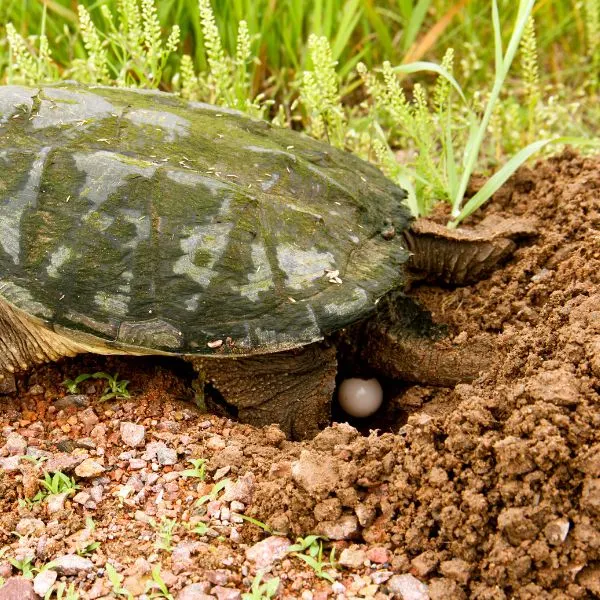
A female snapping turtle depositing eggs in her nest. Snapping turtle eggs are round, white, and about the size of ping-pong balls (roughly 3 cm or 1.2 in across). A typical clutch contains around 20–40 eggs, though large females may lay even more. Each egg has a tough, leathery shell that is slightly flexible when pressed.
Sea Turtles


A green sea turtle laying eggs on a beach at night. Sea turtle eggs are perfectly round, white, and very soft-shelled. They measure roughly 4–5 cm (about 2 inches) in diameter.
A female sea turtle typically lays anywhere from 50 up to 150 eggs in a single nest, depending on the species. The pliable shells allow these eggs to drop into a deep sand chamber without cracking upon impact.
When and Where Turtles Nest
Most turtles lay their eggs in late spring or early summer. In temperate regions, May through July is prime nesting season for freshwater and land turtles. Females leave the water and roam on land to find well-drained, soft soil or sand – often in a sunny spot – to dig a nest. They can be very selective, sometimes trekking long distances to find the right conditions.
Snapping turtles and Blanding’s turtles, for example, have been observed wandering more than a kilometer away from the water in search of a suitable nest site. Using her hind legs, a female turtle digs a flask-shaped hole, lays her eggs inside, then covers the nest with soil (and sometimes leaves) before returning to the water.
Sea turtles, by contrast, nest on ocean beaches (typically at night). In many areas, their nesting season runs from spring into early fall (for instance, roughly May through September in North America). Female sea turtles often return to the same stretch of coastline where they hatched years earlier. They may come ashore multiple times in a season, each time laboriously crawling up the beach to dig a nest in the sand.
Incubation and Temperature
Turtle eggs typically incubate for about 2 to 3 months before hatching. The exact duration depends on the species and the nest conditions. Temperature is a major factor: warmer nests develop faster (hatching in as little as ~50–60 days), while cooler nests take longer (perhaps 80–90+ days). Other factors like humidity, rainfall, and even how deep the eggs are buried can influence incubation time.
Interestingly, the temperature during incubation also determines the sex of most turtle hatchlings. In general, cooler nest temperatures produce mostly males, while warmer temperatures produce more females – often summed up as “cool dudes and hot chicks.” If one part of the nest is warmer than another, a single clutch can yield a mix of males and females. (In some species, extremely high or low temperatures can cause all hatchlings to be female.)
Turtle eggshells are porous, allowing the exchange of oxygen and water. The developing embryos need a warm, moist environment. If the ground is too dry, eggs can desiccate; if eggs become submerged in water, the embryos may drown. In nature, a nest’s soil typically keeps the eggs moist but not waterlogged. In colder climates, eggs that are laid late in the season may hatch very late or the baby turtles will remain in the nest over winter, emerging the following spring once temperatures rise.
What To Do If You Find Turtle Eggs
If you discover turtle eggs or a nest, the best thing to do is usually leave it undisturbed. Turtle eggs are very fragile and sensitive – handling or turning them can kill the embryo. (In many places, it’s also illegal to disturb wild turtle nests.) Mark the location so you remember where it is, and try to keep pets, people, or lawn equipment away. You can protect the nest in place by covering it with something like a wire mesh screen or an upside-down crate secured with rocks. This barrier helps keep predators out while still letting sun and rain through. Just be sure to remove or loosen the cover when the eggs are due to hatch so the baby turtles can emerge.
If the eggs are laid in a high-risk spot (for example, a construction area or a busy backyard path), you might need to intervene. Contact your local wildlife agency or a reptile vet for advice – they can guide you on whether relocation is necessary or permitted. Moving turtle eggs is a delicate process and generally a last resort. Eggs must be kept oriented the same way (marking the top of each egg with a pencil can help) and moved to a similar environment. Whenever possible, it’s preferable to let the eggs incubate naturally where the mother buried them.
For sea turtle nests on beaches, never attempt to dig up or move the eggs yourself. Sea turtle nests are often protected by law. If you find an unmarked nest or see a sea turtle laying eggs, notify local conservation authorities or park rangers. They have protocols to fence off the nest area, post warning signs, or relocate the eggs if absolutely necessary.
Pet Turtle Eggs (Care, Candling, Incubation)
Pet turtles may lay eggs too – even a solo female can lay infertile eggs. If your female turtle is gravid (carrying eggs), provide a proper nesting area (like a box of sand or soil in her enclosure) so she can lay them. This helps prevent egg-binding (when the turtle can’t lay her eggs). Once laid, you can remove the eggs from the enclosure, especially if they might be infertile (unfertilized eggs can rot).
If you want to try hatching turtle eggs, you will need an incubator or a carefully controlled setup. Aim to maintain a steady temperature around 27–30°C (80–86°F) and high humidity (about 80%). Gently transfer the eggs into an incubation container filled with moist vermiculite or sphagnum moss. Make sure not to rotate the eggs – keep each egg oriented as you found it (many hobbyists put a small pencil “X” on the top of the shell to mark the top side). Partially bury the eggs in the moist substrate or rest them snugly so they won’t roll.
Throughout incubation (typically ~60 days, though it can vary), avoid disturbing the eggs. After a couple of weeks, you can candle an egg by shining a small bright light through it to check for veins, which indicate it’s fertile and developing. When the eggs hatch, the baby turtles will have yolk sacs still attached. It’s best to leave hatchlings on a damp paper towel in a warm, safe container until their yolk sac is fully absorbed (a few days to a week). Once that’s done, you can set up the hatchlings in a proper tank with shallow water (for aquatic species), heat, and UVB light, just like any other young turtle.
Species Summary Table
The table below compares some turtle species and their egg characteristics:
| Species | Clutch Size | Eggs (size & shape) | Incubation | Nesting Habits |
|---|---|---|---|---|
| Eastern Box Turtle (Terrapene carolina) | 3–8 eggs | ~3 cm / 1.2 in long; oval, white, pliable shell | 50–70 days | Lays in late spring; shallow soil nests in sunny spots, covered with leaves |
| Red-Eared Slider (Trachemys scripta) | 5–20 eggs | ~3.5 cm / 1.4 in long; oval, soft-shelled | 60–90 days | Nests spring to summer near freshwater; digs nest in sandy or loamy soil |
| Common Snapping Turtle (Chelydra serpentina) | 20–40 eggs (up to ~80) | ~3 cm / 1.2 in diameter; round, leathery shell | 70–120 days | Nests late spring/early summer; often travels far from water to find sandy or gravel soil |
| Eastern Musk Turtle (Sternotherus odoratus) | 2–5 eggs | ~2.5 cm / 1 in long; oval, hard-shelled | 60–90 days | Nests in early summer; very shallow nests near water, often under vegetation or logs |
| Leatherback Sea Turtle (Dermochelys coriacea) | ~80 eggs (plus 20–30 smaller infertile) | ~5.3 cm / 2.1 in diameter; round, very soft shell | 55–75 days | Nests at night on tropical beaches; several clutches per season (every 2–3 years) |
Threats and Conservation
Turtle eggs and hatchlings face many dangers. In the wild, nest predation is a major threat – raccoons, skunks, foxes, snakes, and other predators often sniff out and dig up nests to eat the eggs. It’s estimated that the majority of turtle nests in some areas get raided by predators within days of being laid. Even after hatching, baby turtles are vulnerable to birds, fish, and mammals. As a result, only a tiny percentage (sometimes less than 1%) of eggs ultimately survive to adulthood in nature.
Human impacts have added new threats. Habitat loss means fewer safe places for turtles to nest. Many female turtles are killed by vehicles when crossing roads to reach nesting sites. On some beaches, turtle eggs have been poached (illegally collected) for food or trade. Climate change also poses a risk – higher temperatures can skew the sex ratio of hatchlings, and extreme weather events (droughts, floods, storms) can destroy nests.
Conservation efforts are underway to protect turtle eggs and nesting mothers. On sea turtle nesting beaches, volunteers and biologists often screen off nests or relocate those laid in risky spots. Many areas enforce laws against disturbing turtle nests and impose fines for poaching. For freshwater turtles, wildlife agencies may install nest protectors or predator-exclusion cages and work on creating safe nesting habitats. Public education (such as “turtle crossing” road signs and lights-out campaigns on beaches) also helps more baby turtles survive. Protecting nesting habitat and reducing predators are key steps to improving turtle recruitment (the number of young surviving) and ensuring these ancient reptiles continue to thrive.
FAQs
How many eggs do turtles lay?
This depends on the species. A small turtle might lay just a few eggs (for example, a box turtle may lay 3–5 eggs), whereas a large sea turtle can lay 50–150 eggs in one nest. Most turtles lay somewhere in between, often around a dozen eggs at a time. Many species can also lay multiple clutches of eggs in a single breeding season.
How long do turtle eggs take to hatch?
On average, turtle eggs hatch after about 2 months (roughly 60 days). Warmer temperatures speed up development – some eggs can hatch in as little as 45–55 days. Cooler conditions slow things down – it might take 80–90 days or more. For most turtles, 8–10 weeks is typical under normal conditions.
Do turtles lay eggs in water?
No. All turtles must lay their eggs on land. Even aquatic turtles crawl out of the water to dig nests on shore. If a turtle is forced to release eggs in water (for instance, if she can’t find a nesting spot in time), the eggs will drown and not develop. In nature, every successful turtle nest is on land, not underwater.
Can you move turtle eggs?
It’s not recommended to move turtle eggs unless absolutely necessary. The embryo inside attaches to the egg membrane soon after being laid, and turning or shaking the egg can fatally damage it. In many areas, it’s illegal to disturb turtle nests without a permit. If a nest is in imminent danger and must be relocated, experts carefully dig it up and re-bury the eggs in a similar orientation and environment. This process should only be done by trained professionals.
Are turtle eggs soft or hard?
Turtle eggshells are usually somewhat soft and leathery. They don’t have the hard, brittle feel of a bird egg. When first laid, turtle eggs are often flexible (you could gently dent an egg with your finger and it would spring back). Some species’ eggs firm up a bit over time (and a few, like tortoise or musk turtle eggs, are a bit harder), but generally turtle eggs remain leathery to the touch.
Do mother turtles care for their eggs or babies?
No – mother turtles do not stay to take care of the eggs or the hatchlings. After laying her eggs and covering the nest, the female turtle’s job is done and she leaves. There is no parental protection or feeding of the young in turtles. The baby turtles must survive on their own, instinctively finding their way to water (for aquatic species) or fending for themselves on land.
Sources
- Missouri Department of Conservation – Turtle Facts
- Nova Southeastern University – Broward County Sea Turtle Conservation Program (Sea Turtle Information)
- Farm and Dairy – “Egg-laying season for snapping turtles”
- Turtles Kingston – Blog post on turtle eggs and nesting
- Hepper Pet Resources – “How to Incubate Turtle Eggs” guide
- Wikipedia – Eastern Box Turtle (reproduction and egg details)