
Turtles are smarter than many people think. Their intelligence looks different from mammals, but it is well suited to survival. From long‑distance navigation to long‑term memory, the evidence is surprising.
Table of Contents
The Turtle’s Brain
A turtle’s brain is simpler than a mammal’s, but it is not “primitive.” Key sensory regions are well developed for vision, smell, and spatial processing. Over millions of years, chelonians adapted cognition to fit slow, energy‑efficient lifestyles.
Key term — Carapace/Plastron: The carapace is the top shell and the plastron is the bottom shell. Both house muscles and organs while shaping how turtles move and perceive space.
Navigation & Spatial Learning


Answer first: Sea turtles use the earth’s magnetic field like a map and can retain location information for years. Freshwater turtles and tortoises also show strong spatial learning in lab tasks.
Sea turtles migrate thousands of kilometers (1,000–5,000 km / 620–3,100 mi) and return to natal regions. Experiments show hatchlings and juveniles can learn and respond to distinct magnetic signatures. Turtles also use sunlight and scent as backup cues.
Freshwater and terrestrial species solve mazes and detour problems. Classic work found wood turtles performing on par with rats in mazes, and recent studies show painted turtles can plan detours around barriers. These skills support efficient foraging and homing.
Learning, Memory & Problem‑Solving
Answer first: Several turtles learn by observing, remember solutions for months, and can transfer knowledge between tasks. Their learning is slower than many birds or mammals, but it is durable.
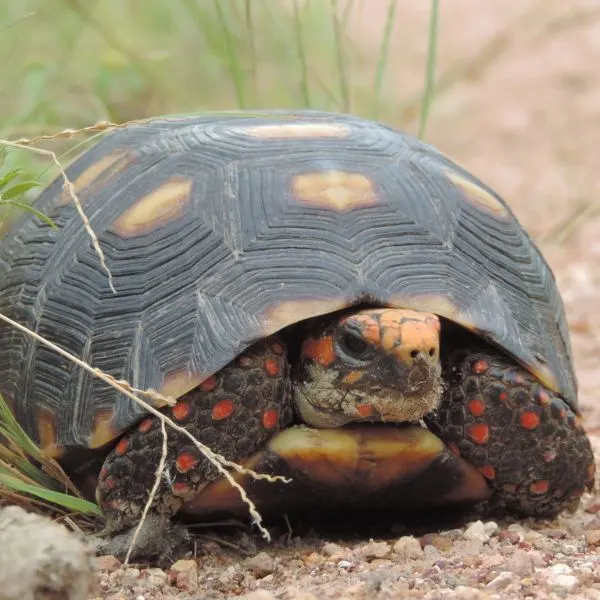
Red‑footed tortoises learn from demonstrations and can solve multi‑step puzzles for food. In touchscreen experiments, they acquire visual rules and apply them to new setups. Follow‑ups show long‑term memory for relative reward values even after long gaps.
Definition — Enrichment: Simple challenges like novel feeders, safe obstacles, and scent trails stimulate problem‑solving. Two to three short sessions per week are enough for most pet turtles.
Do Turtles Recognize People?
Turtles have good vision and can discriminate shapes, patterns, and colors. Many pets learn to approach regular caretakers at feeding time and ignore unfamiliar people.
Direct “face recognition” studies are limited, so treat this as learned association, not human‑like recognition. Consistent, gentle handling and predictable routines speed this learning.
Play & Social Behaviors

Play in reptiles is rare but documented. Reports include object exploration and repetitive “games” that appear to be intrinsically rewarding.
Researchers caution that not all novelty seeking is play. When behaviors persist without food rewards and are repeated for their own sake, they fit scientific definitions of play.
Species Examples
The table below summarizes well‑studied cases. It highlights the skill, a key finding, and why it matters for care and conservation.
| Species | Skill Shown | Takeaway |
|---|---|---|
| Chelonia mydas (Green sea turtle) | Magnetic navigation; natal homing | Uses magnetic “maps” and other cues to travel long distances with precision. |
| Glyptemys insculpta (Wood turtle) | Maze learning; homing | Performs as well as rats in mazes; shows strong homing to familiar ranges. |
| Chelonoidis carbonaria (Red‑footed tortoise) | Social learning; touchscreen tasks | Learns by observation, remembers rules, and transfers knowledge to new tasks. |
| Chrysemys picta (Painted turtle) | Detour problem solving | Plans routes around barriers to reach goals; shows flexible spatial skills. |
Mini‑Profiles (Care & Conservation)
Green sea turtle — Chelonia mydas: Adult carapace length commonly ~90–120 cm / 35–47 in; mass ~70–200 kg / 154–441 lb. Distributed in tropical and subtropical oceans; nests on sandy beaches.
Threats: Fisheries bycatch, coastal development, light pollution, climate‑driven sex ratio shifts. Conservation: Nest protection, bycatch reduction devices, dark‑sky beach policies, international trade controls.
Wood turtle — Glyptemys insculpta: Carapace length ~14–20 cm / 5.5–8 in. Northeastern North America in forested river systems with gravelly banks.
Threats: Road mortality, illegal collection, habitat fragmentation. Conservation: Head‑starting, road‑crossing structures, riparian habitat restoration, strict trade enforcement.
Red‑footed tortoise — Chelonoidis carbonaria: Carapace length ~30–35 cm / 12–14 in. Found in South American savannas and forest edges.
Threats: Harvest for food/pet trade, habitat loss. Conservation: Regulated trade, protected areas, community education to reduce harvest pressure.
Painted turtle — Chrysemys picta: Carapace length ~10–25 cm / 4–10 in. Ponds and slow waters across much of North America.
Threats: Wetland loss, roadkill, nest predation by subsidized predators. Conservation: Wetland buffers, nest protection, wildlife‑friendly road design.
FAQs
Are turtles smart?
Yes—relative to their needs. They excel at spatial memory, navigation, and learning rules that help them find food or safe routes.
Which turtle is the “smartest”?
Wood turtles and red‑footed tortoises are frequent standouts in lab tests. Sea turtles lead in large‑scale navigation and long‑term map memory.
How do sea turtles find their way back?
They detect latitude‑ and longitude‑like features in Earth’s magnetic field. Over time they refine a “magnetic map” and use sun and smell as backup cues.
Do turtles recognize their owners?
Many learn to approach familiar people who feed them. That is best described as learned association using strong visual discrimination.
How can I enrich my turtle’s mind?
Try short, safe challenges two to three times weekly. Rotate puzzle feeders, add scent trails with soaked pellets, and vary basking platforms.
Quick routine: 1) Present a simple detour to reach food. 2) Offer a novel object to inspect. 3) End with a predictable reward to reduce stress.
Can turtles learn tricks?
They can learn simple, repeatable tasks tied to food rewards. Keep sessions brief, consistent, and low‑stress for best results.
How long do turtles remember things?
Studies show months‑long retention of learned rules and reward values. Their learning is slow to acquire but slow to forget.
Sources
- Nature (2025). Experimental evidence that loggerhead turtles learn magnetic cues for navigation.
- Smithsonian Magazine overview of turtle magnetic learning and “magnetic map” research.
- Cambridge University Press (2016). Reptile Cognition and Behaviour (chapter on chelonian learning).
- Biology Letters (2016). Long‑term memory of relative reward values in tortoises.
- Behavioural Processes (2014). Touchscreen performance and knowledge transfer in red‑footed tortoises.
- Animal Behavior and Cognition (2022). Painted turtles solve detour problems.
- COSEWIC/Environment Canada. Wood Turtle status report (maze learning and homing notes).
- Peer‑reviewed reviews on play in ectotherms and reptiles.