
There are 7 living types of sea turtles. The seven sea turtle species are the flatback sea turtle, green sea turtle, hawksbill sea turtle, Kemp’s ridley sea turtle, leatherback sea turtle, loggerhead sea turtle, and olive ridley sea turtle.
Sea turtles are air-breathing marine reptiles that live most of their lives in the ocean. Adult females return to beaches to nest, and many species migrate long distances between feeding areas and nesting beaches. Species, age class, health, migration stage, nesting status, habitat, ocean temperature, food availability, pollution, fishing pressure, boat traffic, and climate change can all affect survival and behavior.
This guide compares the seven species, shows how to identify them, explains where they live and what they eat, and covers their conservation status and the safest ways to help them.
Types of Sea Turtles Quick Answer
The 7 types of sea turtles are flatback, green, hawksbill, Kemp’s ridley, leatherback, loggerhead, and olive ridley. Six of the seven occur in U.S. waters. The flatback has the smallest range and is mostly associated with northern Australia and nearby continental shelf waters.
Sea turtles are not pets. They are protected marine wildlife. Injured, stranded, nesting, or entangled sea turtles should be reported to local wildlife authorities, a sea turtle stranding network, or the appropriate marine wildlife hotline. Do not touch, feed, ride, chase, move, or disturb them.
Sea Turtle Species at a Glance
This table gives a quick comparison of the seven species. Sizes and weights vary by sex, population, and measurement method, so use these as practical adult ranges.
| Common name | Scientific name | Adult size and weight | Range or habitat | Natural diet | Global IUCN status |
|---|---|---|---|---|---|
| Flatback sea turtle | Natator depressus | About 31 to 37 inches. Up to about 220 pounds. | Northern Australia, southern Indonesia, Papua New Guinea, and nearby continental shelf waters. | Benthic invertebrates, crustaceans, mollusks, and sometimes jellies. | Data Deficient |
| Green sea turtle | Chelonia mydas | About 3 to 4 feet. Often 300 to 500 pounds. | Tropical and subtropical coastal waters, seagrass beds, lagoons, reefs, and nesting beaches. | Adults mostly graze seagrass and algae. Young turtles eat more mixed plant and animal foods. | Least Concern globally, with several threatened subpopulations |
| Hawksbill sea turtle | Eretmochelys imbricata | About 2 to 3 feet. Often 100 to 150 pounds. | Tropical reef habitats, rocky areas, lagoons, and nesting beaches. | Sponges, reef invertebrates, algae, and other reef foods. | Critically Endangered |
| Kemp’s ridley sea turtle | Lepidochelys kempii | About 2 feet. Often 70 to 100 pounds. | Gulf of Mexico and western Atlantic, with key nesting in Mexico and Texas. | Crabs, shrimp, mollusks, fish, and other benthic prey. | Critically Endangered |
| Leatherback sea turtle | Dermochelys coriacea | About 5 to 6 feet. Often 750 to 1,000 pounds, with some much larger. | Open ocean, long migrations, nesting beaches in tropical regions. | Jellyfish, salps, and other soft-bodied gelatinous prey. | Vulnerable globally, with several critically endangered subpopulations |
| Loggerhead sea turtle | Caretta caretta | About 3 feet. Often 200 to 375 pounds. | Coastal waters, continental shelves, estuaries, open ocean, and nesting beaches. | Hard-shelled prey such as conchs, whelks, crabs, clams, and other invertebrates. | Vulnerable globally, with some threatened subpopulations |
| Olive ridley sea turtle | Lepidochelys olivacea | About 2 to 2.5 feet. Up to about 100 pounds. | Tropical ocean waters, coastal foraging areas, and mass nesting beaches in some regions. | Crabs, shrimp, jellyfish, fish, tunicates, algae, and other opportunistic foods. | Vulnerable |
Global Red List status does not replace local protection. Regional populations may have different risk levels, and sea turtles are protected by national and international laws in many places.
How to Identify Sea Turtle Species
Sea turtle identification usually starts with the shell, head, beak, size, and habitat. Good photos from a safe distance can help trained responders or researchers, but do not approach or disturb a turtle just to identify it.
| Trait | What to look for | Species clues |
|---|---|---|
| Shell texture | A leathery shell with raised ridges instead of hard scutes. | Leatherback |
| Shell shape | A flatter, lower-profile shell with a limited Australian range. | Flatback |
| Head size | A large head with powerful jaws. | Loggerhead |
| Beak shape | A narrow pointed beak and patterned shell. | Hawksbill |
| Body size | Small adult size compared with most sea turtles. | Kemp’s ridley or olive ridley |
| Shell and diet clues | Smoother shell, rounded profile, and adult grazing on seagrass or algae. | Green sea turtle |
| Nesting behavior | Mass daytime nesting events called arribadas in some locations. | Olive ridley and Kemp’s ridley |

For broader identification help, use our turtle identification guide, turtle species hub, and turtle and tortoise terms glossary.
The 7 Types of Sea Turtles
Each sea turtle species has a different body shape, range, diet, and conservation story. The sections below give a practical overview and link to deeper species guides.
Flatback sea turtle


The flatback sea turtle has a low, flatter shell profile and one of the smallest ranges of any sea turtle. It nests along northern Australia and uses nearby continental shelf waters around northern Australia, southern Indonesia, and Papua New Guinea.
Flatbacks feed mostly on bottom-dwelling invertebrates such as crustaceans, mollusks, and other soft-bodied prey. Their global IUCN status is Data Deficient, which means there is not enough information for a full global risk assessment.
Read more in the full flatback sea turtle guide.
Green sea turtle


Green sea turtles are named for the greenish color of their fat, not for the color of their shell. Adults mostly graze on seagrass and algae, although young green turtles eat a more mixed diet before moving into nearshore feeding areas.
Green sea turtles are often seen near seagrass beds, reefs, lagoons, and coastal waters. Their global IUCN status is now listed as Least Concern, but several regional subpopulations remain threatened, and green turtles in U.S. waters are still protected under the Endangered Species Act.
Read more in the full green sea turtle guide.
Hawksbill sea turtle


Hawksbill sea turtles are reef-associated turtles with narrow pointed beaks and beautifully patterned shells. Their beak helps them feed in reef crevices, where they eat sponges and other invertebrates.
Hawksbills are globally Critically Endangered. Their shells were historically used in the tortoiseshell trade, and illegal trade continues to threaten them in some regions.
Read more in the full hawksbill sea turtle guide.
Kemp’s ridley sea turtle
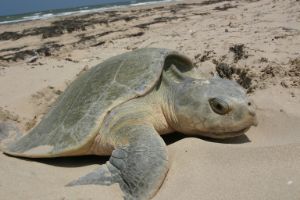

Kemp’s ridley sea turtles are the smallest sea turtle species. They are best known for nesting along the Gulf of Mexico coast, especially in Mexico and Texas, and for mass nesting events called arribadas.
Kemp’s ridleys feed on crabs, shrimp, mollusks, fish, and other benthic prey. Their global IUCN status is Critically Endangered, which makes them one of the most at-risk sea turtle species.
Read more in the full Kemp’s ridley sea turtle guide.
Leatherback sea turtle


The leatherback sea turtle is the biggest sea turtle. It has a leathery, ridged shell instead of a hard scute-covered shell, which makes it easy to separate from the other six species.
Leatherbacks migrate long distances and feed mainly on jellyfish, salps, and other soft-bodied open-ocean prey. Their global IUCN status is Vulnerable, but several regional subpopulations are Critically Endangered or Endangered.
Read more in the full leatherback sea turtle guide.
Loggerhead sea turtle


Loggerhead sea turtles are named for their large heads. Their strong jaws help them crush hard-shelled prey such as conchs, whelks, crabs, clams, and other bottom-dwelling invertebrates.
Loggerheads use coastal waters, continental shelf habitat, estuaries, and open ocean habitats at different life stages. Their global IUCN status is Vulnerable, but some regional subpopulations are more threatened than others.
Read more in the full loggerhead sea turtle guide.
Olive ridley sea turtle


Olive ridley sea turtles are small ocean-going turtles with olive-gray shells. They are famous for arribadas, where many females come ashore to nest in the same area over a short period.
Olive ridleys eat a varied diet that can include crustaceans, jellyfish, shrimp, fish, fish eggs, tunicates, algae, and other available prey. Their global IUCN status is Vulnerable.
Read more in the full olive ridley sea turtle guide.
Sea Turtle Conservation Status
Sea turtle conservation status depends on the source, region, and population. Global IUCN status is useful for broad comparison, but national legal protections may be stricter. The six species found in U.S. waters are all protected under the Endangered Species Act.
| Species | Global IUCN status | Important context |
|---|---|---|
| Flatback | Data Deficient | Limited range and less global data than other sea turtles. |
| Green | Least Concern globally | Several subpopulations remain threatened. Legal protection still applies in many regions. |
| Hawksbill | Critically Endangered | Threatened by habitat loss, reef decline, bycatch, and illegal tortoiseshell trade. |
| Kemp’s ridley | Critically Endangered | The smallest and one of the rarest sea turtles. |
| Leatherback | Vulnerable globally | Several subpopulations are Critically Endangered or Endangered. |
| Loggerhead | Vulnerable globally | Some subpopulations are more threatened than the global listing suggests. |
| Olive ridley | Vulnerable | Still faces bycatch, egg harvest, habitat loss, and coastal development threats. |
For more conservation context, read why are sea turtles endangered, sea turtles and pollution, and sea turtles struggle for survival.
Biggest, Smallest, and Rarest Sea Turtles
The leatherback is the biggest sea turtle. It can reach about 5 to 6 feet in adult length and often weighs hundreds of pounds. Some exceptional leatherbacks are much larger.
The Kemp’s ridley is the smallest sea turtle. Adult Kemp’s ridleys are often about 2 feet long and around 70 to 100 pounds.
The rarest living sea turtle is usually considered the Kemp’s ridley because of its small population and Critically Endangered status. Hawksbills are also Critically Endangered globally, and some leatherback populations are in severe decline.

For a size-focused guide, read how big are sea turtles.
Can Sea Turtles Be Kept as Pets?
No. Sea turtles are protected marine wildlife, not pets. They should not be collected, bought, sold, kept in private enclosures, fed, touched, ridden, or handled by the public.
Sea turtles may only be handled, transported, rehabilitated, housed, or studied by properly permitted wildlife professionals, aquariums, researchers, veterinarians, or stranding-response teams. Laws vary by country and region, but private keeping is not appropriate or legal for ordinary pet owners.
Readers who want to support sea turtles should choose legal conservation options instead. Learn about symbolic support in how to adopt a sea turtle.
What to Do If You Find a Sea Turtle
If you find a sea turtle, hatchling, nest, stranded turtle, injured turtle, entangled turtle, or dead turtle, keep your distance and contact local wildlife authorities or a sea turtle stranding network. Do not touch, push, drag, feed, pour water on, or move the turtle unless an authorized responder tells you exactly what to do.
On nesting beaches, keep lights off, avoid flash photography, stay quiet, and give the turtle space. Hatchlings should be allowed to crawl on their own. Do not pick up hatchlings or carry them to the ocean.
If you are in the United States, contact the state wildlife agency, NOAA regional hotline, local stranding network, or beach patrol where posted. In Florida, the Florida Fish and Wildlife Conservation Commission provides guidance for what to do if you see a sea turtle.

Major Threats to Sea Turtles
Sea turtles face natural predators, but the largest modern threats are tied to human activity. Threats vary by region and species.
| Threat | How it affects sea turtles | Species most affected |
|---|---|---|
| Bycatch | Sea turtles can be caught in commercial or recreational fishing gear. | All species |
| Entanglement | Fishing line, nets, ropes, and debris can trap turtles or stop them from surfacing. | All species |
| Plastic and marine debris | Turtles may eat plastic or become entangled in trash. | All species |
| Boat strikes | Turtles near the surface can be injured or killed by vessels. | Coastal species and nesting-area populations |
| Light pollution | Artificial light can deter nesting females and disorient hatchlings. | Nesting females and hatchlings |
| Coastal development | Development can reduce nesting habitat and change beaches. | Nesting species |
| Egg, meat, and shell trade | Direct harvest and illegal trade reduce populations. | Especially hawksbills and some nesting populations |
| Climate change | Warmer sand can affect hatchling sex ratios, and rising seas can flood nests. | All nesting species |
| Disease | Some populations face disease concerns such as fibropapillomatosis. | Especially some green turtle populations |

For more on diet and pollution risks, see what do sea turtles eat, do sea turtles eat jellyfish, and what eats sea turtles.
How to Help Sea Turtles Safely
You can help sea turtles without touching them. The safest help usually means reducing disturbance, reducing pollution, and reporting problems to trained responders.
- Keep beaches clean, dark, and flat during nesting season.
- Fill holes and knock down sandcastles before leaving the beach.
- Remove beach chairs, umbrellas, and gear at night.
- Turn off, shield, or redirect lights visible from nesting beaches.
- Never release balloons or leave plastic waste near waterways.
- Pick up fishing line, hooks, and trash safely.
- Follow boating speed zones and watch for turtles near the surface.
- Choose responsible wildlife tours that follow local viewing rules.
- Report injured, stranded, entangled, nesting, or dead sea turtles to the proper authority.
For travel-related reading, see best places to dive with sea turtles, snorkeling with sea turtles, turtles in Hawaii, turtles in Puerto Rico, turtles in Mexico, and turtles in Australia.
Responsible Sea Turtle Viewing
Responsible sea turtle viewing means letting the turtle control the encounter. Do not chase, crowd, feed, touch, ride, block, follow, or surround sea turtles in the water or on the beach.
NOAA marine life viewing guidance recommends staying at least 50 yards from sea turtles when viewing by watercraft, avoiding sudden speed or direction changes, and not feeding marine turtles. In the water, use local rules and tour guidance, keep a respectful distance, and never block a turtle’s path to the surface.
When visiting nesting beaches at night, avoid flashlights, camera flashes, and bright screens. Artificial light can confuse hatchlings and disturb nesting females. If you see a nesting turtle, stay back, stay quiet, and follow posted local rules.
Types of Sea Turtles FAQ
How many sea turtle species are there?
There are 7 living sea turtle species. They are the flatback, green, hawksbill, Kemp’s ridley, leatherback, loggerhead, and olive ridley sea turtles.
What are the 7 types of sea turtles?
The 7 types of sea turtles are flatback sea turtle, green sea turtle, hawksbill sea turtle, Kemp’s ridley sea turtle, leatherback sea turtle, loggerhead sea turtle, and olive ridley sea turtle.
Which sea turtle is the biggest?
The leatherback sea turtle is the biggest sea turtle. Adults commonly reach about 5 to 6 feet and weigh hundreds of pounds, with some individuals much larger.
Which sea turtle is the rarest?
The Kemp’s ridley is generally considered the rarest living sea turtle. It is also the smallest sea turtle species and is globally Critically Endangered.
Are all sea turtle species endangered?
Not every sea turtle species has the same global IUCN status, but all sea turtle species face serious threats. Six species occur in U.S. waters, and those six are listed and protected under the Endangered Species Act.
Can sea turtles be kept as pets?
No. Sea turtles are protected marine wildlife, not pets. They should not be collected, kept, bought, sold, handled, fed, or moved by the public.
How can you identify different sea turtle species?
Look at shell texture, head size, beak shape, shell profile, scute pattern, body size, and habitat. Leatherbacks have leathery ridged shells, hawksbills have pointed beaks, and loggerheads have large heads.
What should I do if I find a sea turtle on the beach?
Keep your distance and contact local wildlife authorities, a sea turtle stranding network, or a posted hotline. Do not touch, move, feed, pour water on, or disturb the turtle unless an authorized responder tells you what to do.
Conclusion
The 7 types of sea turtles are flatback, green, hawksbill, Kemp’s ridley, leatherback, loggerhead, and olive ridley. They share a marine lifestyle, but each species has its own size, shell shape, range, diet, nesting behavior, and conservation story.
The best way to help sea turtles is to protect them from a distance. Learn to identify them, keep beaches clean and dark, reduce plastic waste, boat carefully, choose responsible wildlife tours, and report stranded or injured sea turtles to trained responders.
For more sea turtle reading, visit sea turtles, sea turtle facts, sea turtle migration, sea turtle hatching season, and where do sea turtles lay their eggs.
Sources
- NOAA Fisheries, Sea Turtles
- IUCN SSC Marine Turtle Specialist Group, Red List Assessments
- The State of the World’s Sea Turtles, Sea Turtle Species
- Sea Turtle Conservancy, Sea Turtles
- NOAA Fisheries, Marine Life Viewing Guidelines
- NOAA Fisheries, What Can You Do to Save Sea Turtles?
- Florida Fish and Wildlife Conservation Commission, What to Do If You See a Sea Turtle